Showing posts with label Soft-Hackle Presentation. Show all posts

Sunday, June 2, 2019

Summer Trout

 It's summer.

At left, a purchase from a winter ago: The Hardy Cascapedia in the 4/5 trout size. I'm torn as to which fishing buddy to leave it to because without a doubt, there'll be a knife fight in the attorney's parking lot over the thing.

I got to meet John Shaner this spring who is the East Coast "Mr. Hardy" among other things. I'm told he had a hand in the re-emergence of this wonderful piece of gear.

He's a super guy and has an encyclopedic knowledge of wet flies, the origins of the North American dry fly tradition, and and and. Besides this, he's a super guy you'd want to introduce to your sister.

I got a bit of stage fright in meeting him.

I fed him and our crew dinner -- a special special Italian affair with great wines (Thanks Scott!) and meatballs someone dear to me taught me to make -- but except for "Hello, glad to meet you" I couldn't bring myself to ask him to sign my old copy of Bergman's Trout.

It goes back to meeting Buck Buchanan in the day (NFL HOF 1990). He died at age 51 of lung cancer. When I met him as a kid, he was the largest man I'd ever seen. I thought he was a giant. I'd watched him on television with my dad and here he was shaking my hand. All I could do was stammer.

I had a date with a girl once who was so beautiful I couldn't talk to her. My only hope was to talk at her while focusing on the foreign businessman and his wife over at the table behind her. The fellow probably thought I was gay the way I kept staring at him. Every time I looked at her, I lost my voice.

Luckily I covered my embarrassment in alcohol because that always helps, right?

With Shaner, I covered it by vicodin and an early trip to bed while everyone else ate and talked. I didn't even get into the dining room. I twisted my ankle the day before and the bastard had swollen to the size of a softball while pounding like it was on an anvil. I wasn't good company.

I'm the king of pissed-away opportunities.

So, the Cascapedia is delightful. It's spooled with OPST Lazar line and I left room to handle a whole fly line in 4/5. I'm going with a Rio LT in DT 4 wt.

Yes, at 6+ ounces someone will say "isn't that heavy?"  The difference between the Cascapedia and a Galvan Torque is about two ounces. That's a couple slices of ham. I'm not going to feel the difference.

I'd say I'm not casting postage-scale light rods but that isn't true. I've an 8' WInston BIIIx in 4 wt and a Hardy Zephrus 8' 4wt  both that are in that light class.  I know 8'6" is the better length in both rods; but, I live in Michigan and 8' is just fine. I prefer the McKellip M84 8' cane but it rains here and one must make concessions.

You don't have a problem with cane in the rain? Good on you. I have and I do.

Anyway, I bought this reel something more than a year ago and have been using it for single-handed Spey work and some double-handed on a 3 wt Echo 10' 6" 3 wt. It's loaded with OPST Lazar line and backing. The thing is large. I've left enough room to make a loop-to-loop for the LT DT from Rio in 4 wt.

I'm tying.

 In sorting some boxes, I've segregated some flies from the collection for this coming weekend on the Au Sable and Manistee both of which are unseasonably -- and uncomfortably -- high.

  Big coachman-style streamer with a double hackle head inspired by the low-water spey flies Steve at The Soft-Hackle Journal ties. Mine aren't as clean or neat; but, the big hydraulic wake of the twin hackles does something special on 12" strips and BOOM trout take 'em.  Size 7  Alec Jackson irons hook here.


 A nice red-assed inspired wire wrapped soft-hackle that does well in finding the underwater soft seam below faster surface current.  Fish lying in that gravel channel under the flow take this beast with gusto which is good because I often have enough slack in my system on the take that I need the assist.


Black and palmered in a wide-gap #14. Always helpful in softer water when things are still a bit higher and faster than usual.


I'm making the run to do a "dry camp" up on the Manistee at the ruins of Deward.

The river is small there and high water won't hurt the brookies. I'll swing a hammock (Hennessy - now a 20 year old beast good as the first day new) and use a Ranger stove from the Solo Stove people as my portable fire pit. It's a lightweight camp confined by distance-from-road restrictions.

Hey, we all want to enjoy the unspoiled wilderness so some camping restrictions are in order.

Hope summer smiles on you. It was a long time getting here.

Prost.

Wednesday, May 15, 2019

The Neversink Unique Area

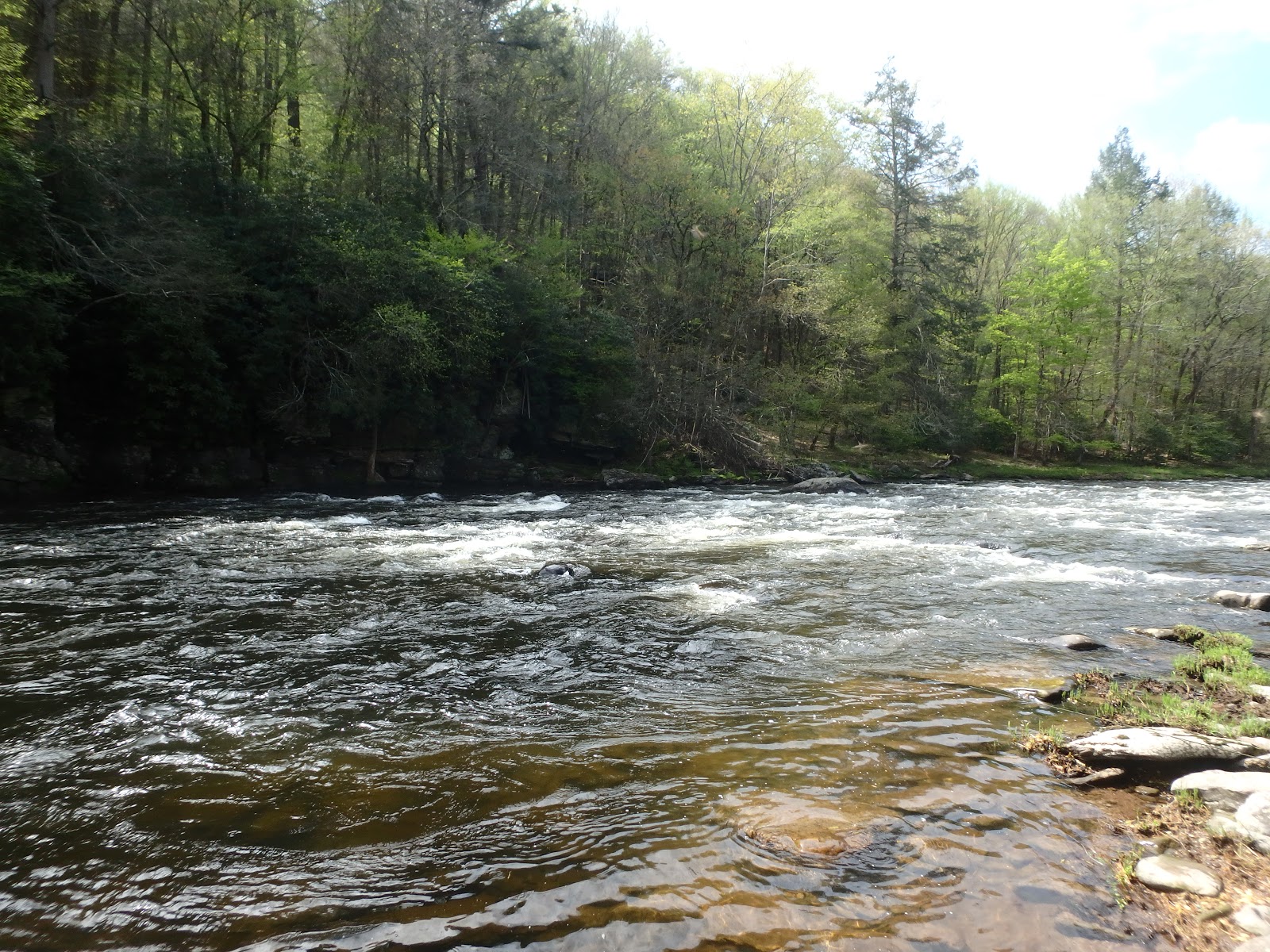
AT left, a picture from the Neversink well inside the Unique Area looking down on the river itself. In this picture, flows are three times normal as measured at an upstream gauging station. The debris from a couple weeks ago is another six feet up the banks! That must have been something to see.

I took a fish out of the slick in the bottom right corner.

The water had a slight cast -- green, Jim says -- but visibility exceeded 20 feet. I had the head of a Wulff TT line out plumbing the depths off a rock ledge and I could see my bead-head PTN flymph just ticking the bottom rocks as the color transition on the line denoting the head was in my hand.

Our lunch spot. Jim in foreground. Riffled break goes up around the bend. A long slick is a my back.

We've hiked in about an hour mostly downhill to reach this spot.  The day began with light rain and a cold drizzle and became this warm spring day with full sun. It topped 70 by the time we hiked out.

We were supposed to have storms but none materialized. We could hear thunder in the north as we hiked out.

The downstream lunch view. Halfway down a brook emerges from behind Jim.

The humidity was up: tropical, even.  The river valley was set to "coastal".

The blackflies were out in hordes. We endured though I'm covered in small itchy welts. Mildly annoying at the time. Mildly annoying now.

Black flies are not deer flies and the bites are  in the "discomfort" range. Deer flies are far worse.

The small brook in its last pool before tumbling to the Neversink.

It is water very much like Alan fishes on Small Stream Reflections in the right sidebar. The little fellow ran full but the very steep plunges seemed to dissuade the brookies.

I tried a Wulff in size 18 here. Nothing rose. My suspicion is that my over zealous approach put the fish down. Has to be one in there.


This lovely fellow in the 16" - 18"  class (net holds a 21" when stretched so I have a good comparison)  came from the foot of the flow where the brook (above) runs into the Neversink.

This was a very quick in-net photo and the lens is slightly fogged from being in my shirt pocket in this very high humidity.  I'm standing one foot in the brook looking out to the river.

He lacked girth but was long like a cat stretched out on your leg. I frequently encounter cat-on-leg so it comes to mind readily.

He took a partridge-and-yellow in size 12, wire wrapped with a piece of .20 non-lead tied-in along the shank. It sank well and I had to guide it downstream about sixty feet from where I could stand in the brook in order to clear some car-sized submerged rocks.

The fight to get him to my net was as exciting as I've had in years. Current, strong fish, rocks. My heart was pounding and my smile hurt my cheeks.

The emergence point of the small brook featured above. That current tongue on the right which meets a poorly illustrated lateral seam from the Neversink proper was just where I caught the trout.

I took my  snapshot, declared my prize, and moved on to let Jim have a shot at what clearly was a wonderfully fish-y spot.


The lunch spot riffle-run. The high water and fast current induced standing waves I don't suspect are standard on the Neversink.


A line of riffles from submerged rocks running across to the rock bluff just coming into view on the far left of the frame. It is much prettier in person than the flattened perspective of a snapshot allows.

The seam 1/3 the way across the river held a deep pool and it yielded a nice trout.


An 8" - 10" class trout from the bottom of a Neversink pool. Lovely coloration on this guy. He received a quick lift -- tail still in the stream -- for the snap.

I like this method of photographing fish as he was exposed to air for less than a five-count. It isn't the best fish picture in the world but we've all seen fish and he could use a break.

I've enough "grip-and-gin" for a lifetime.

He's kinda cute in this one.


I fished a Hardy 8' 4wt Zephrus with a Douglas 3" Argus reel and a Wulff TT line in 4.  The high water really made the aggressive roll cast the means of fishing. The 4wt was fine for the day.

The Neversink in the Unique Area is really good cane water. The early drizzle and the threat of storms made me bring plastic. I have a nice 8' 4/5 Steffen Bros. fiberglass blank laid up by Mark McKellip but I grabbed the Hardy because I wanted to see how it did with dry-fly in the field. New rod from the winter purchases.

Alas, we saw a half-dozen risers but couldn't reach across the river to get to them. My 6wt Winston Boron III Plus I used on the Beaverkill would have allowed me to make the presentation but I suspect -- correctly -- the rod to be overkill for the standard trout in narrow confines.

A four weight gave me thrills on the large fish and enjoyment with the smaller. Lots of bugs off the water; but, little surface action.

I tried the litany of soft hackles -- some dressed to the film, others in the top 8" or so and a few lightly weighted with wire wraps for the top 18"-24". Nothing.

I lost several fish on long lines fishing deep swings with weighted black, orange, and a couple snipe and purple soft-hackle flymphs tied with tungsten beads in #14 and #16. I used a long-line nymphing technique (no bobber) and a long leader greased at the junction with the fly line. I could hook-up using the barbless ties even in strong currents with a lot of line.  I only brought one of these to hand however.

The fish in the net above took a cdc caddis in grey drowned by a current tongue and carried nearly across the bottom of a pool. I could see the flash of the take.

The current was too high for wading as pictured.  We fished from the banks and a few rock-hops.

From the hike through the forest.


The Neversink Unique Area is well worth the hike. It's easy to find a day's worth of water and we saw no other anglers. A mile on foot seems to be the measure that sorts the crowds.

In the increasingly crowd-fished Catskills, the Neversink offers the isolated adventure one needs.

Prost.

Monday, February 19, 2018

My Upstream Presentation of Soft-Hackled Flies


 I've caught a little "amber liquid" flack over the Baked Goods Illustrated segment of this blog. Seems the latest photos imply a degree of haughty achievement full of airs and illusion far outside the realm of normal Amber Liquid fare.

At left, this week's installment. I was off the leash while Beargirl was gone and indulged in forbidden food. In this case: pigs in a blanket.

Hebrew National dogs in a light biscuit dough. They were delightfully in the amber liquid wheelhouse.

No Bisquick here. That stuff tastes like Play-Doh. Yes, I know what Play-Doh tastes like. Doesn't everyone?


My Modern Wet Fly Code  would read: upstream, to a rising trout, from the river, with a soft-hackled wet.

Sound familiar? Yes, it is very much the pattern of upstream dry-fly. I'll outline below my upstream presentation tactics. Please, feel free to suggest where I might have gone awry. I catch fish using these techniques. Unlike Datus Proper, no trout I've asked has offered any sort of comment on my approach.

I'll keep asking.


My Upstream Presentation:

Soft-hackled flies are killers. However, there is a perception that they are swung down-and-across in an attention-absent manner suitable for the very young and very old. I say bullshit. These flies are best when actively fished. The upstream presentation is a good example.

The great WC Stewart of The Practical Angler fished his soft-hackles upstream with great success and he was surely a meat hunter: he paid his bills with his freshwater catch.

There's great sport in the soft-hackled fly. It takes a change of mindset to find it initially; but, once realized then all manner of technique is open to the angler. All it takes is a little nudge.

This little piece might be that nudge for someone.

A word on fly selection for the upstream scenario: I outline below a scenario in terms much as I fish a dry fly to a feeding trout. I fish soft hackles shallow in the same manner. To sighted feeding fish, I'm fishing so near the surface that I'm watching the take.

If I've no sighted fish and I'm fishing to habitat, I'm usually fishing deeper in the water column and I'm watching line and tippet for evidence of takes just as if freestyle nymphing in Colorado.

I do cheat and tie-in a piece of hi-vis Stren into the leaders I use for fishing deep in the water column when fishing early in the season. I haven't the ingrained ability to be able to pick up the gear on the first outing and manage subsurface takes with any great skill. Come July, I'm fine and can hook-up on the slightest twist. In March and April, I'm slow to see and slow to take up slack on a strike. A little more leader visibility helps me "re-tune" the lizard-brain so I don't have to think then react. I'll just be able to react.

Another cheat? A duo rig. Even deeply subsurface, the upstream approach outlined below is essentially the same when fishing a buoyant indicator fly over a spider. Just open your casting loop which for the majority of recreational anglers isn't a concern at all.


Above: a quick illustration of a scenario.

The Scenario:

I'm fishing upstream and have approached after thoroughly working the snag at the upper right of the picture. Edging across the current I see rising fish nearly mid-stream. I see feeding trout. If I'm fortunate, I see a large solitary trout who otherwise lives under the sweeper/snag pool but who is out on the town for a quick feed.

I'll say that there are several holding lies in this illustration. There's probably a nice cutbank in the bank's swale upstream of the sweeper/snag. There could well be a nice hole or gouge where I've shown the angler due to past high-water flows that washed out a soft bit of sand bottom during the spring spates. The current would shift at normal flows and I've seen trout holding in the deeper water especially when the bottom is black with mud or organic detritus.

No, here I see the riseforms from trout picking off bits from the bubble seam given by the tips of the mostly lateral timber or from the break of the current in its swing. I've labeled the area as "The Zone."

My bank is steep and alder-filled or otherwise undesirable as a platform. Frequently, some sort of draping limbs obstruct a backcast. It's Michigan.

My Approach:

I'm cutting the distance. I advance a half-step at a time. Small steps mean less wake, and less toe-force in the forward movement should I inadvertently strike a submerged boulder. To the trout, kicking rocks in wading boots makes a sound remarkably like the drum line of the Phantom Regiment. Not helpful.

I approach based on water depth. At waist deep, I crowd 20'. Maybe a little closer if I can sneak up to the tail of the lateral timber. Shallower water knee to mid-thigh depths I stand back to 30'.  I sometimes kneel if I have a shallow tailing bar. I don't need the leverage for a long cast so I minimize my form anticipating something going wrong.

The Rig:

Surface/near-surface observed feeding means a long tippet. In early summer, I frequently use 3' to 4'  of 4x on the end of a leader then 3' of 5x or 6x.  Fly size and whim determines my terminal tippet. A size 11 jingler gets the more aggressive tippet. A size 17 partridge-and-orange gets the 6x. I should also say that I hand-tie my leaders to turn over duo rigs. My leaders are a little stiffer so tapering the tippet helps.

The Preparation:

I pick the most downstream fish. I watch. I'm looking for patterns. Do they stray towards the lateral timber indicating some sort of nervous pattern? Are they "hogging" in mid-stream slashing at anything alive? Can I pick out the rise timing of individual fish? Are there bubbles from open-mouth surface feeding or are they bulges of a porpoising feed subsurface? I observe.

I can always change my fly before the cast is made.

I look nearby. Several times I've found a larger fish subtly feeding nearby while the smaller fish make a commotion in mid-stream. My best was spotting a nice brown feeding just outside the overhanging grass of a cutbank while smaller fish fed as a pod pretty much where I've shown "the zone" in the illustration above.

It only takes a couple minutes to look carefully.

The Cast:

I'm targeting a midstream fish.

The curve cast [Pete Kutzer demonstrating here] -- a laterally overpowered cast which curves the end of the leader and fly one way or another -- is perfect here. I rarely use it. Fancy casts amid structures and obstructions tossed in with the pressure of a sighted fish often means bad things. Remember, I'm not a commercial fisherman (e.g. guide, fly shop owner, outdoor writer, factory rep, pro-staff member). I'm working on being the occasional angler. Simple. Reliable. Repeatable. This is the mantra of success.

Your golf pro would say "play within yourself."

I deposit the soft-hackle upstream and to one side of my sighted fish. I anticipate the current providing a little cross-current drift (3" - 4") based on strength of flow and I use this to move the fly into my quarry's feeding zone. So, I'm casting 9" - 16" to the left bank side of my sighted fish. I'm dropping-in something like 2' - 3' upstream of the fish. I've made a choice. I'm letting the fish hit the fly on the drift. I want him to see, target, and take. 

I'll use a side-arm cast place the fly over a clear area judging the distance. Then, with my estimation complete I make the terminal cast.

If I've no place to prep the terminal cast, I'll use a roll-cast with my attention to the travel of my rod-tip. I execute a perry-poke with a short pile of line in front of me, aggressively build a "D" loop,  and cast forward to a hard stop a little higher in the motion than I first think necessary. My rod tip has no arc. None. (ed. - dual fly rigs need a little arc to open the loop and avoid tangles. I get excited and  omit this arc in pressure situations and tangle on the cast. Don't be like me.).

Having the line, leader, and fly straighten in the air and fall 1'-2' to the water with a little rebound slack is better than rolling across the water over the fish driving the fly into the surface with a "plop." Always better to "alight" on the water than pound and splash under pressure.

A little rebound induces natural leader slack and that helps the fly's initial drift, too. It lands and often spins a little frequently drawing a strike from other than the targeted fish. That sort of problem isn't  a bad one to have.

The Drift:

The drift is short. I'm covering at most one-third the distance of the cast. The fly is well in front of me when I decide to recast. I use a clean roll-cast pick-up to "snip" the fly off the water.

If I'm pressed for room and limited to roll-cast only I'll downcast the now aerialized line so that the fly is one rod length ahead and to my right.  I'll snap another roll-cast to a targeted fish. This is a single-handed spey technique.

Sometimes, I just reset and try the whole routine from speed zero rather than going cast-to-fish-to-cast. There's no harm in resetting. Too many anglers ruin things in haste.

The Set and Play:

I manage tension and line control by lifting my rod tip and using my line hand. I'll lift a rod tip to forty-five degrees to keep line off the water. Note I say lifting my rod tip and not my rod.

I can lift my whole arm 3" for a set or (preferred)  use a strip set from my line hand. What I don't want to do is raise my rod arm in managing line then attempt a set with my wrist striking with a rod-tip lift.

I don't want to end up with a strike at the end of a short managed drift with my rod arm raised as if I'm holding the leash on a giraffe. I've no control then. I'm "wrong footed" and cannot play a trout from that starting position.

I say this because I have seen anglers in such an awkward position.

Conclusion:

My approach outlined here is overly exhaustive. I wanted to outline exactly what my upstream process involves so that anglers who only know the down-and-across swing have some idea of what approach might work. I catch fish in the manner described.

Ask a guide. He'll catch more fish in a different manner.

Upstream to feeding fish represents a great deal of fun. Upstream to habitat and pulling fish up to the surface is also great fun.

Fishing upstream in the bottom one-third of the water column is every bit as technical as freestyle nymphing. Yes, the fish do sometimes hook themselves. Far more often they'll spit the hook before you see the take unless your nymphing skills are strong. I don't recommend upstream dredging for trout, at first.

Upstream soft-hackle is one of the most enjoyable means of fishing water in small to mid-sized rivers. When the hatch season begins, it can be a deadly approach.

Hopefully, it leads to a double-digit trout day. It has for me.

Soft-hackles saved my Michigan fishing experience.

Prost.