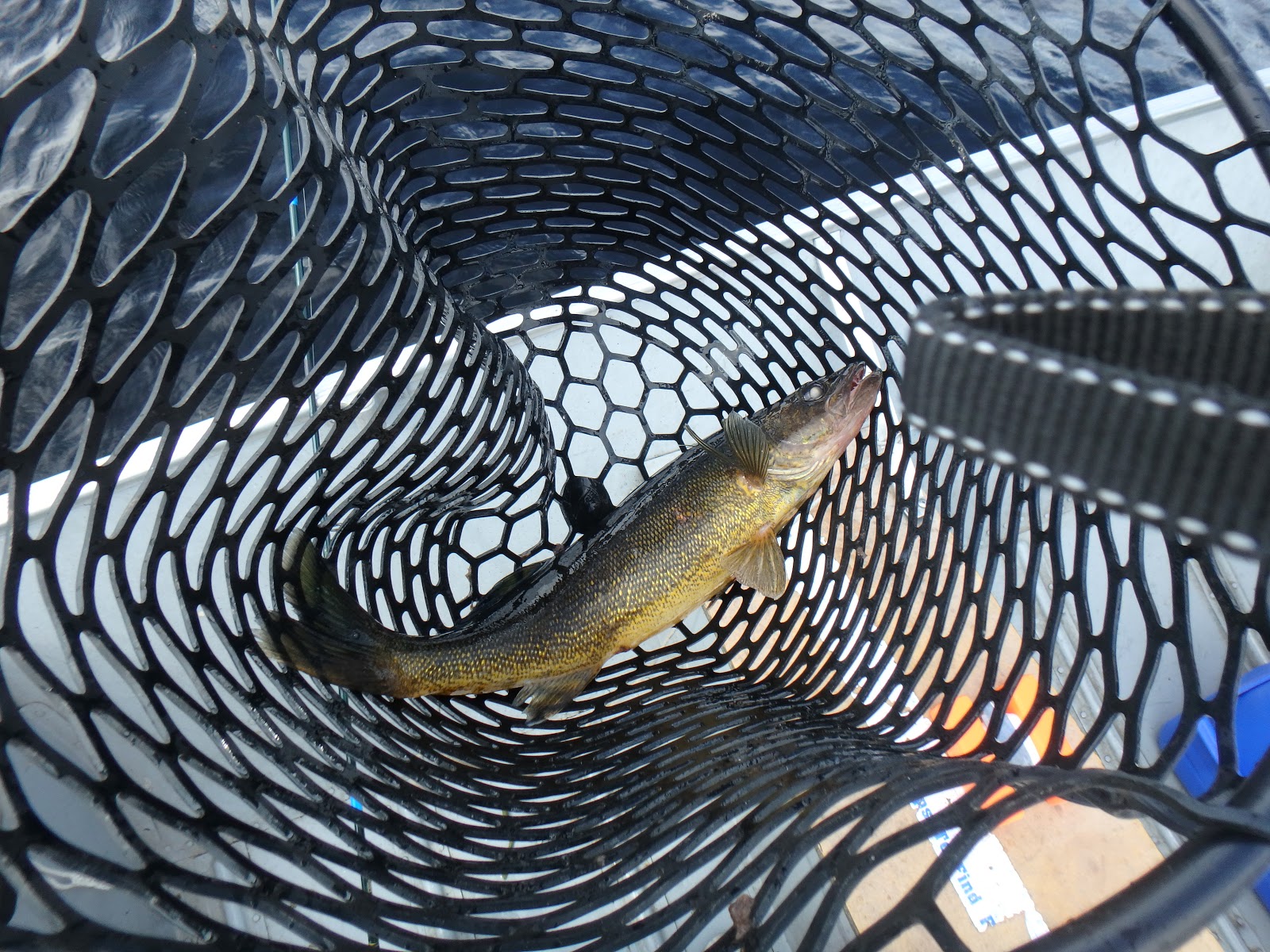
Showing posts with label fishing report. Show all posts

Thursday, August 29, 2019

The Wabakimi Report

It isn't about trout. Rather, it is the Canadian fly-in experience.  We were on the lake the first week of August and I've been playing catch-up at work and home (new beagle moved into the house when I returned).

So photos and comments:

The toasted ham-bacon-egg breakfast sandwich. Huge hit this trip. Wrapped in a paper towel and foil and it is a boat-ready breakfast.


Fishing partner after drive to Canada. We're at the Hideaway Lodge in Emo, Ontario. Doug and Kathy are great hosts, though Kathy has grown tired of our 4:30 AM fly-out bit.


Cloud tops, Fly-out morning. Low ceiling today.


My seatmate: Moki the Power Hoe. He's got a new Briggs-built engine and is on the way to Wabi with me. The thing is pretty much just possessed. The hoe, when running, is subject to random thrashing. Yea - it was manhandled out of the plane.


The Otter all tatted-up like a 70's conversion van.


Nice work, though.


My $2200 fish. (First fish).


Mike's first fish (mine's bigger ... though that was the smallest he caught all week).


Bear swimming. Best photo I have. We saw two. This was the best snap.
Gut bucket.


Guts on bushes of island guarding our lagoon.


Trying for an eagle pic. He's shy and won't come down. Gulls are however not camera shy.


Guts always attract an audience ... this time my fishing partner.
Rare snap of Mike driving the boat. He ran over the buoy. Hooked a buoy 4 times. Hooked the anchor line.

Subsequently fired.


 Morning prior to a day's outing.


An a panorama of the lagoon.


Going through the Honey Hole to the Lower Wabi.


Thanks for indulging me. I'm not going back for a couple years and this trip will always be special. Too much travel to cover and Wabi has been good to me. Time to see some other country, too.

Wednesday, May 15, 2019

The Neversink Unique Area

AT left, a picture from the Neversink well inside the Unique Area looking down on the river itself. In this picture, flows are three times normal as measured at an upstream gauging station. The debris from a couple weeks ago is another six feet up the banks! That must have been something to see.

I took a fish out of the slick in the bottom right corner.

The water had a slight cast -- green, Jim says -- but visibility exceeded 20 feet. I had the head of a Wulff TT line out plumbing the depths off a rock ledge and I could see my bead-head PTN flymph just ticking the bottom rocks as the color transition on the line denoting the head was in my hand.

Our lunch spot. Jim in foreground. Riffled break goes up around the bend. A long slick is a my back.

We've hiked in about an hour mostly downhill to reach this spot.  The day began with light rain and a cold drizzle and became this warm spring day with full sun. It topped 70 by the time we hiked out.

We were supposed to have storms but none materialized. We could hear thunder in the north as we hiked out.

The downstream lunch view. Halfway down a brook emerges from behind Jim.

The humidity was up: tropical, even.  The river valley was set to "coastal".

The blackflies were out in hordes. We endured though I'm covered in small itchy welts. Mildly annoying at the time. Mildly annoying now.

Black flies are not deer flies and the bites are  in the "discomfort" range. Deer flies are far worse.

The small brook in its last pool before tumbling to the Neversink.

It is water very much like Alan fishes on Small Stream Reflections in the right sidebar. The little fellow ran full but the very steep plunges seemed to dissuade the brookies.

I tried a Wulff in size 18 here. Nothing rose. My suspicion is that my over zealous approach put the fish down. Has to be one in there.


This lovely fellow in the 16" - 18"  class (net holds a 21" when stretched so I have a good comparison)  came from the foot of the flow where the brook (above) runs into the Neversink.

This was a very quick in-net photo and the lens is slightly fogged from being in my shirt pocket in this very high humidity.  I'm standing one foot in the brook looking out to the river.

He lacked girth but was long like a cat stretched out on your leg. I frequently encounter cat-on-leg so it comes to mind readily.

He took a partridge-and-yellow in size 12, wire wrapped with a piece of .20 non-lead tied-in along the shank. It sank well and I had to guide it downstream about sixty feet from where I could stand in the brook in order to clear some car-sized submerged rocks.

The fight to get him to my net was as exciting as I've had in years. Current, strong fish, rocks. My heart was pounding and my smile hurt my cheeks.

The emergence point of the small brook featured above. That current tongue on the right which meets a poorly illustrated lateral seam from the Neversink proper was just where I caught the trout.

I took my  snapshot, declared my prize, and moved on to let Jim have a shot at what clearly was a wonderfully fish-y spot.


The lunch spot riffle-run. The high water and fast current induced standing waves I don't suspect are standard on the Neversink.


A line of riffles from submerged rocks running across to the rock bluff just coming into view on the far left of the frame. It is much prettier in person than the flattened perspective of a snapshot allows.

The seam 1/3 the way across the river held a deep pool and it yielded a nice trout.


An 8" - 10" class trout from the bottom of a Neversink pool. Lovely coloration on this guy. He received a quick lift -- tail still in the stream -- for the snap.

I like this method of photographing fish as he was exposed to air for less than a five-count. It isn't the best fish picture in the world but we've all seen fish and he could use a break.

I've enough "grip-and-gin" for a lifetime.

He's kinda cute in this one.


I fished a Hardy 8' 4wt Zephrus with a Douglas 3" Argus reel and a Wulff TT line in 4.  The high water really made the aggressive roll cast the means of fishing. The 4wt was fine for the day.

The Neversink in the Unique Area is really good cane water. The early drizzle and the threat of storms made me bring plastic. I have a nice 8' 4/5 Steffen Bros. fiberglass blank laid up by Mark McKellip but I grabbed the Hardy because I wanted to see how it did with dry-fly in the field. New rod from the winter purchases.

Alas, we saw a half-dozen risers but couldn't reach across the river to get to them. My 6wt Winston Boron III Plus I used on the Beaverkill would have allowed me to make the presentation but I suspect -- correctly -- the rod to be overkill for the standard trout in narrow confines.

A four weight gave me thrills on the large fish and enjoyment with the smaller. Lots of bugs off the water; but, little surface action.

I tried the litany of soft hackles -- some dressed to the film, others in the top 8" or so and a few lightly weighted with wire wraps for the top 18"-24". Nothing.

I lost several fish on long lines fishing deep swings with weighted black, orange, and a couple snipe and purple soft-hackle flymphs tied with tungsten beads in #14 and #16. I used a long-line nymphing technique (no bobber) and a long leader greased at the junction with the fly line. I could hook-up using the barbless ties even in strong currents with a lot of line.  I only brought one of these to hand however.

The fish in the net above took a cdc caddis in grey drowned by a current tongue and carried nearly across the bottom of a pool. I could see the flash of the take.

The current was too high for wading as pictured.  We fished from the banks and a few rock-hops.

From the hike through the forest.


The Neversink Unique Area is well worth the hike. It's easy to find a day's worth of water and we saw no other anglers. A mile on foot seems to be the measure that sorts the crowds.

In the increasingly crowd-fished Catskills, the Neversink offers the isolated adventure one needs.

Prost.

Monday, May 13, 2019

The Beaverkill Pools

The core of my Catskill trip revolved around "the five" : west and east branches of the Delaware, the Beaverkill, the Willowemoc, and the Neversink.

These five constitute a career's worth of water. If one were to fish no other streams, there would be enough here for fifty years and a dozen styles of fishing from wispy two-weight dry fly midges on tiny brooks to true Spey-style swings for deep-holding large trout across massive waters.

Our style of dry fly fishing here east of the Mississippi originated in flies inspired by those sent by Frederic Halford to Theodore Gordon. Gordon slightly altered the appearance of some patterns to more closely resemble those of insects hatching in the Catskill system illustrated at left and thus began the "Catskill-style" fly fishing of surface dries.

Certainly there were independent origins of dry fly development and the products likely evolved into the synthesis of what we consider now; but, the spiritual heart of the dry fly emerged and was re-enforced by the presence of  writers and their east coast readership who had the means and leisure to pursue fly fishing in this region. Other factors for fame include the introduction of brown and rainbow trout into brook trout fisheries decimated by deforestation and over-fishing.

Today I want to speak of the classic pools of the Beaverkill. My hand drawn map at the above is an inexact approximation; but, as you look at it, we're dealing with the section in the middle from East Branch upstream on the Beaverkill to Roscoe where the Beaverkill is joined by the Willowemoc  adding a considerable amount of water to the flow.

The famous pools begin inside the town of Roscoe on its southwest side with Junction Pool. The river and its pools are paralleled by Old Highway 17 throughout this length which makes the park-and-fish angler its principal population but for a couple of locations.

New Highway 17 (4-lane divided highway) is seldom out of sight and less out of earshot. There is little illusion of fly fishing classic waters from the early 1900's in the presence of singing tires and jake brakes from tractor-trailer rigs slowing on curves.

The pools are easy to find for they all bare large signs. Here is Junction Pool's:

We're in town at Roscoe.  I'm standing on a bridge abutment. There is a smallish parking lot here with room for half-a-dozen cars. The Roscoe Motel is across the road just behind me and to the right.


And, the pool. That's new Route 17 in the background. There is some sort of light industrial building across the river separated from the bank by a large chain-link style fence. The rip-rap on the bank is natural stone but still appears to be dumped by a highway department probably after the erosion caused by the massive flood of 2006.

Anglers fish this stretch rod to rod standing on the shallow inside from where my picture is staged and casting to the channel passing by the far bank. Only one angler was fishing when we arrived -- a rare occurrence -- but the whole place had the air of "fish harvest." All that was missing was a large salmon trap floating against the bank with its arms slowly turning to the cadence of  the harvesting march. (Sounds a bit like Panzerleid to me).

The aroma of combat fishing hung too strongly in the air. We passed and moved along.

The pools on the Beaverkill are close together and flow one into another. Below the Junction Pool is Ferdon's Pool named for the Ferdon family. Oddly, it is this pool where the first Hendrickson fly was tied by a guide named Roy Steenrod for the famous Mr. Hendrickson for whom the Hendrickson Pool is named. All very confusing, I'll admit.

Below the Ferdon's Pool is Barnhart's pool. Sign at left. Pool pictured below.


That's Neall from the Painted Trout on the bank. My other pictures turned out poorly. It's a  pool of water  reached by a hike of a quarter mile or so across flat -- and sometimes a little muddy -- meadow. There is room for four or five anglers here if they know one another.


The Famous Hendrickson Pool. I took a couple fish here. The rocks are brutal. B.R.U.T.A.L.

I'd say you must have a staff here. The current was assertive but the footing was treacherous with rocks distributed across the bottom ranging from basketball to ottoman sized. And ... they move.

I twisted an ankle bad enough I'm still limping here a week later. I just taped it up at fish camp and continued fishing. You might be a strong wader and able to avoid trouble. I didn't. The folks that fished this water one hundred years ago must have been tough.
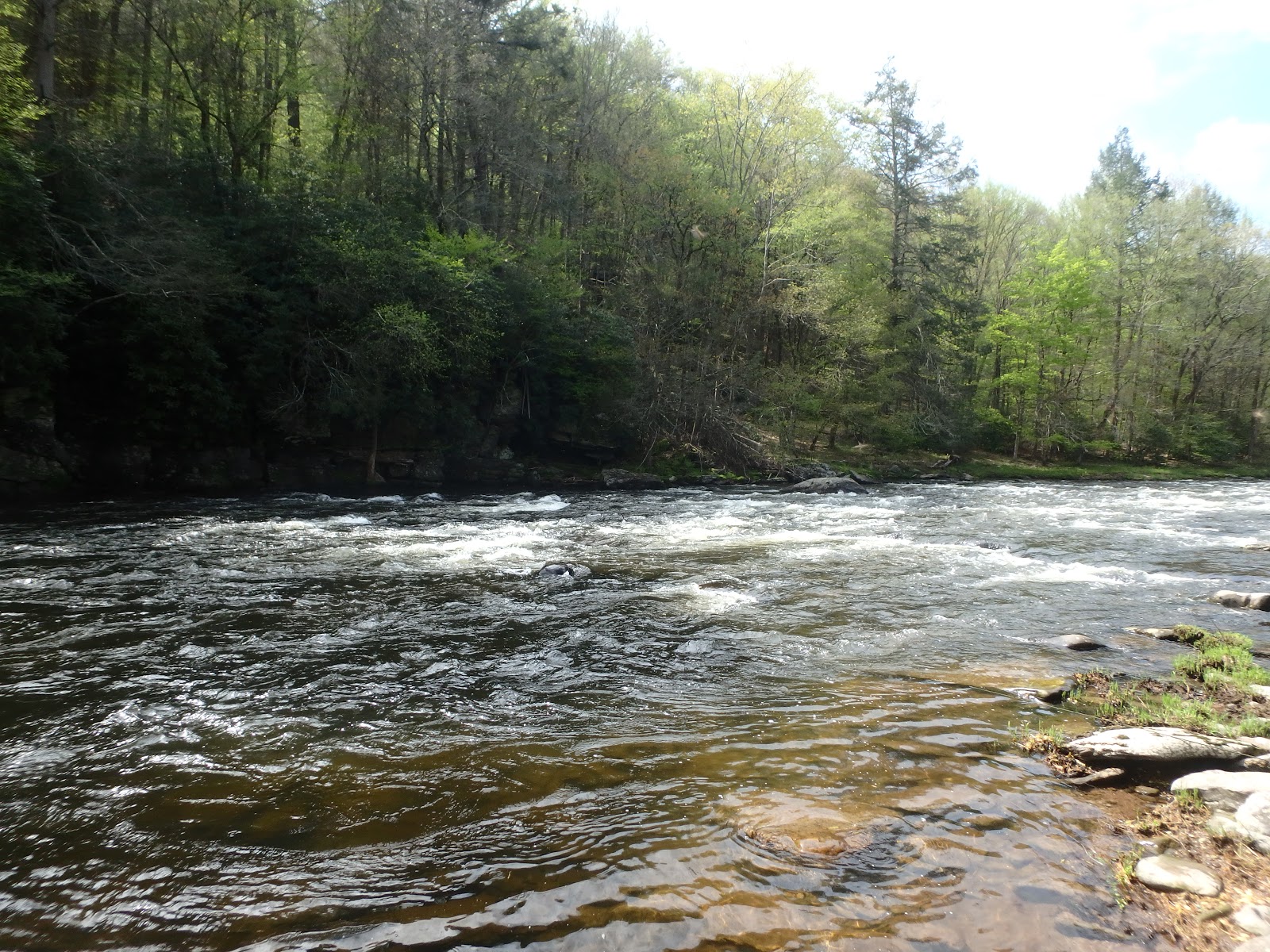
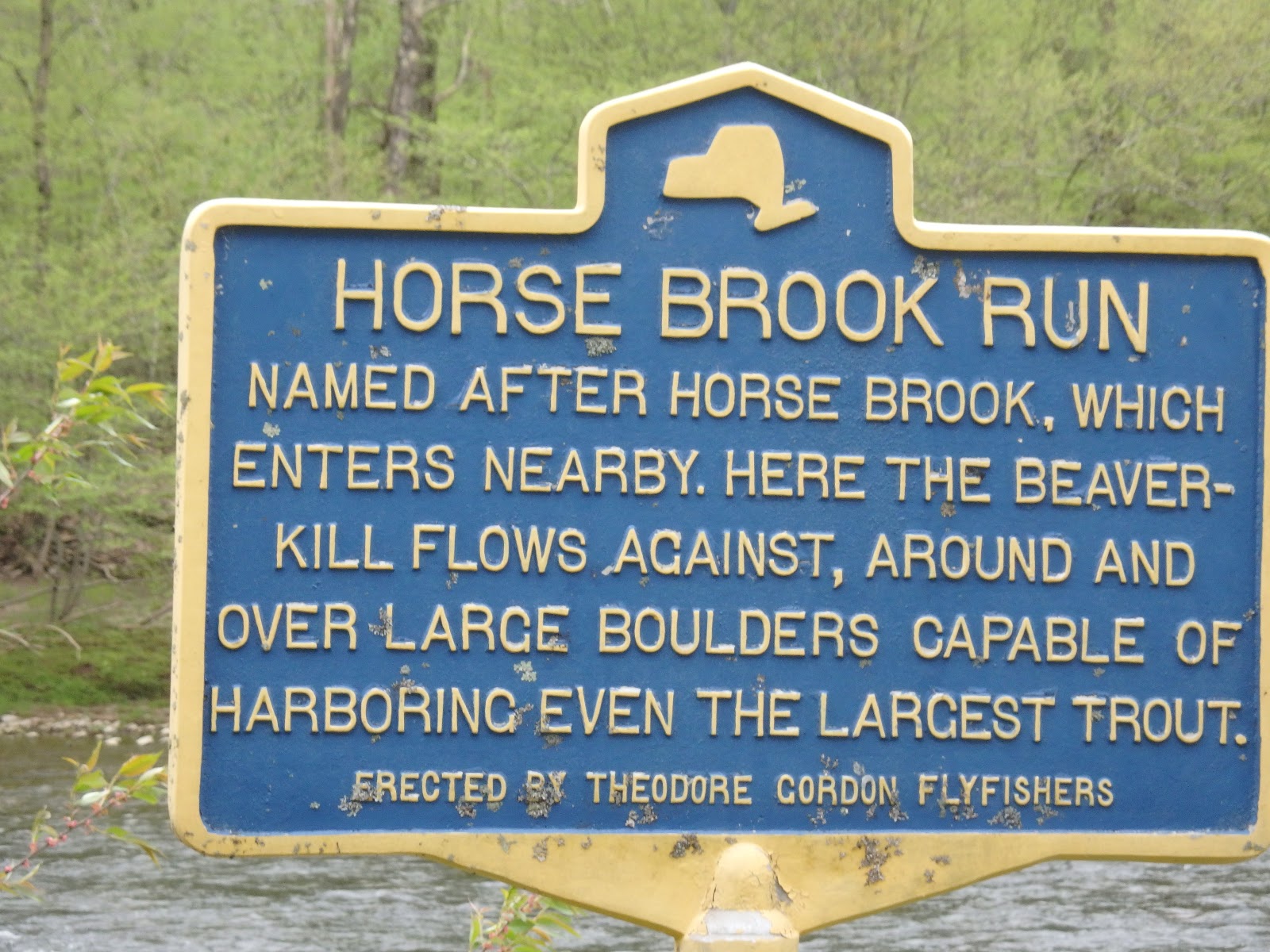
Hendrickson's Pool above on the far left side of the snap as we look down the long flow and the bend toward Horse Brook Run named for Horse Brook which enters halfway down from the right side of the frame. That is old RTE 17 running down the right. The bank is thirty feet of rip-rap and is steep.

Horse Brook.


Beadhead flymph of the type I used to take my two trout in two hours from Hendrickson's. The body of these is a black or root beer dubbing spun in a loop to form a thorax, a hen pheasant tail, and a substantial dark hackle below the bead. The fly is a size 10  1 xl. I lost many in the pinch-points between the irregular rocks. I did however take fish.  No one else did.

Stonefly? Iso? Leech? The fly worked.

I asked the trout. They wouldn't talk. Probably knew I was a softie and was going to be quick returning them to the stream.

There are a number of successive pools one after another denoted with signs and located right along the old highway.

We stopped and fished after passing the other pools all of which were occupied by anglers in early afternoon. Painter's Bend just above Cooks Falls presented a nice flow and a nice rainbow for my fishing partner Jim Page.


Jim playing a rainbow.

Wading was much better here. The depth across the pool is mid-thigh with a few slightly deeper slots. Jim is on a cobble tongue so is in a little less water.

The current was stiff but the low depth made it fine to fish. I swung everything in the arsenal a little upstream from here and found nothing. From the riffles below Jim is a section of more than a mile of pocket water. When it is warmer, I'll go back to pick these pools at dusk. My ankle was tender so a great deal of movement in the stream was not high on my list of activities when this snap was taken. I was pretty much just "icing" it in very cool water and practicing my single-handed Spey technique.

I fished a Winston BIII Plus saltwater rod in 9' 6 wt here on the Beaverkill and that was about right. I used a Cascapedia rigged with OPST running line, heads, and tips. With the current, a fourteen inch trout  put up a solid fight with fifty feet of line out up at Hendrickson's Pool. Here at Painter's, I didn't think a four weight had enough for control.

A conventional nine foot five was probably right but I wanted to use the Winston.


The panorama of Painter's gives some idea of the course of water. There is a great deal of it here and a party of five or six could easily fish without being in each other's way providing again that they know each other.

In a day,  we stopped at five pools; drove past a half-dozen more occupied by anglers; and enjoyed the river immensely. This little section of the "upper no-kill" on the map could take an entire season to learn to fish. There are a great many anglers in the Catskills. There is water to hold them.


My favorite sign from the trip is above.

If you are curious, I recommend Fly Fishing the Beaverkill  by Eric Peper and Gary LaFontaine (The Lyons Press. Guilford, Connecticut. 1999).  This slim book prepared my crew well for the Beaverkill and the famous pools including bits of the area's history and the naming sources.

Our crew which included two guides and a North American manager for a major fly fishing gear manufacturer struggled at times.  Our party had over 250 years of fly fishing time and still the fish were a little tight-lipped. I felt fortunate to get two fish this day. The professionals were blanked -- different water, though.

The fishery is changing. Guide boats have exploded in the past ten years. At one point, we counted nine boats in a line on a stretch of the Delaware. I heard a story of nineteen trailers at a take-out.

Now, I'm not too anxious to pay $400 to follow another boat all day pool to pool. YMMV.

There are no boats on the famous stretch of the Beaverkill. At lest, there are no boats that would last a season or that wouldn't have to be pulled over humps in the case of rafts. This is wade fishing territory and the better for it.

The fish in the pools I covered above see a great many flies.

Like the Au Sable here in Michigan, fish are moving more and more towards nocturnal feeding. They've had dries, bobber-nymphs, and bank-pounding streamers thrown at them. They're responding.

Three fish  constitute a fine day on most of this famous water. A decade ago, you'd expect three in an hour. I've never been much of a numbers guy. I like to catch fish but am content with any fish for my effort.  Considering I was sight fishing new water, I'm more than happy with a couple of fish taken in spring from the bottom third of the water column.

I saw a handful of splashy rises, surmised subsurface feeding based on rise form, and pursued. My soft hackle efforts in the top third produced nothing. Jim took a rainbow on a nice soft-hackle hare's ear flymph.

You pays your money. You takes your chance.

Prost.

Wednesday, May 1, 2019

And It's On: Opener

Jim and I on the Black River. Photo courtesy a very nice spin fisherwoman: Mikalea.  We sent her to the Fly Girls for conversion to a hobby that will take all her money and time.

Jim and I have tied flies together on Monday nights for the last three years.

We camped through a full gale at Town Corner Campground and had a great day on the water.

I saw fish ... swimming past my feet ... at the bottom of the stream.

SO, a shut out. Not even a strike at a streamer.


One of many streamers tried.

The night before opener dipped to 25 or below. Coldest it has been in weeks. I was out adjusting lines at 2:30 in the morning and my breath turned to ice crystals instead of fog vapor. It was plenty cold (I slept in my 0 degree Marmot bag. Jim had a summer bag and a 10 lb Hudson Bay wool blanket. We were both fine.)

We felt bad about not managing a single brookie.

Then, opener evening we broke camp and went to a party for "commercial fishermen" hosted by a fly shop owner we know. Great time. Fisheries folk. Guides. Gear reps. It was awesome. Jim and I were the only non-industry forks there besides our host's husband.

We decided on the way down to just admit we were blanked. After all, we're in this for the hobby.

Turns out, no one else had a fish either. Made me feel better. Some of the folks there couldn't get on the water because of blown-out streams or -- in one case -- a horrible case of "wrong turn" due to faulty memory. It happens to us all.

So, sometimes the pros have trouble. I might have thought it was just an off day for part of the group but when a guide I now who can catch fish in the puddles of the parking lot on the way to the river was blanked, I feel better.

Fish at my feet.

Brook trout on the Black can be spooky. I decided to stand motionless in one particularly good spot for most of an hour to see if anything would come on and hatch figuring that my immobile stance world give me an idea if my clumsy wading, staff tip on cobble, shadow, or just general movement might be the culprit keeping fish down.

Fish did show up in three-and-a-half feet of gin clear water swimming upstream past my feet. No interest in my nymphs, flymphs, soft-hackles, or the assortment of streamers tried later in the day.

It was great to be out. It wasn't so great to have one of those days where nothing in my arsenal seemed to be the right bit. At least I can be sure that better fishermen than I suffered similar fates and I didn't get the "you shouda tried an orange bean pock ... they were taking 'em like crazy!" story.

Next up: New York and the Catskills next week.

Warmer water promises different outcomes. Those streams are also blown out and prone to overcrowding but being brook trout guys, our outing group are willing to hike away from crowds up into headwaters.

Prost.

Sunday, June 4, 2017

Fish Not Pictured


Dward Tract fishing report, Manistee River, MI.

At left, a fine example of my recent fish photography. A lovely brookie was in this paw an instant before the shutter snapped. He's out of frame in this yet not quite in the water.


I went to the Au Sable / Manistee region for a trout dash camping trip this weekend. Gates had this as the sign: a classic.


I caught these. The big one - a lovely nine-to-ten incher - flipped out of my hand in the upper picture. Those I captured on the digital film roll looked more like this little guy. Lovely, though a little bleached. Only the large fish had a lot of heavy shading.

I can't tell if this fellow has nice color or not. Lost on me.


I fished using this nice little 7' 2/1 #4/5 by Chris Lantzy. It's a lovely mortised handled split cane rod here mounted with a Douglas Argus wearing Wulff TT in #4. The rod does fine with the #4 or the #5 Wulff line.

My Hardy Marquis is spooled with the #5 but that reel does not like grit at all. I fished it in the Wisconsin trip and it saw a little of the milkshake water. All cleaned-up now but I think it is about to be shelved for a Red Truck.

Chris' rod is a joy to cast and will roll cast the snot out of the Wulff lines. Perfect for the tight confines seasoning the Deward tract on the Manistee.


Beauty shot of a guide on the mortised rod with the Deward tract Manistee in the background at Stump Forest.


Above is "the hole" I worked on Saturday afternoon. It was a development exercise I set for myself.

I figured three catchable fish lived here in the bend (probably more like fifteen). I was determined to fish for them with dry, soft hackle wet, dry-dropper, weighted flymph under a wool tuft (indicator), and streamer.

You can see the cover, the current, and the dark turn of a hole which is a good six foot deep over there. The water in the foreground was about fourteen inches deep on my shin. I sat, thought, planned, and observed.

I slowed down and contrived to catch three fish.


Flies used.


I studied the hatch. It was largely mosquito as shown here for size.


Pictured is an old old ginger-caddis leftover from before I started tying cdc-DHC exclusively. Not a bad tie, though.

Maybe a little head heavy. Size 16 here.

My hook left less sting than this smashed fellow. He was not a practitioner of the barbless philosophy.


Girding my loins using the default Michigan mosquito repellent: heavy sleeves.


And "no joy."  I fished from a low angle slightly off and upstream so as to use the current to help me with the submerged obstructions.

I stayed low so as not to soil the hole. I got into position and sat for 20 minutes waiting for my bank-side footsteps to fade from memory.

No joy. Odd.

Otter? Osprey? Brown trout in the hole?

I failed the exam. There is something here I did not know or did not execute correctly.

Puzzle:

I took nine fish off this stream. Five I took wading downstream returning to my put-in. I "jigged" my soft-hackle in the drift downstream 50' in front of me (full line head + leader) loosing one and hooking five.

What? Why?

My upstream soft-hackle efforts full of concentration and stealth yielded worse results than "playing" a brown partridge-and-orange downstream in the main current drift. No hatch. No spinner fall. Partly cloudy day with a 10 - 12 mph irregularly gusting wind. I had waded up the stream long enough before to consider it fully rested.

Was I "chumming" the stream with my steps? I didn't think so but the results might say otherwise.

My delicate and dedicated fishing of "the hole"  pulled nothing. The fish I did catch from upstream presentations came from places unremarkable (not a visible seam off a sweeper or on/around a obstruction).

I  fished "water" and not fish. I used the "9 box" method of dividing the stream into three ranks (rows) and three files (columns) upstream but within my reach. I fished closest to me across the rank, then the next rank upstream. Then the next. Three or four steps and I repeated.

I have this nasty nagging feeling I'm too high in the water column for fish feeding close to the bottom while lying in the micro draws and troughs of the streambed.

I suspect. I suspect. I postulate. I guess.

I think I am fishing shallow. I will amend the effort next weekend on that trout dash upstate.

Beauty Shot of gear:

I love my Finn Utility side bag. It isn't perfect; but, neither am I.

It's lovely gear. It needs a little Lexol in this snap.


Spike Burger and waffle fries. Fished shallow or deep, these hook me every time. Forbidden food.

"Not for Bears."


The evening fire as I read and smoked the last of some Briar Fox from Cornell and Diehl. Sad to say, it hasn't become a favorite blend.

Next up is Sextant by G. L. Pease. Yes, it is slightly cased by rum -- as if that matters a damn bit.

I've nothing bad to say about a little rum casing in the tobacco from time to time.

Rum is a fine substitute for Irish Whiskey or a decent scotch  in a glass when you're pressed to it.

One must remain flexible, after all.

Prost.