Showing posts with label Flies. Show all posts

Tuesday, September 3, 2019

Flies and Flies: Driftless


AT left, my Pink Squirrel. As my wife reminds me, I am completely colorblind and she asks: "is it supposed to be a purple squirrel?" The Ice Dub bag said "pink."

Going to the Driftless here in a week with some novice and some not novice fly fishermen. It's a mixed bag.

We'll be artificial but a couple of the guys are clearly more about "fishing trip" than "fly fishing trip" which is fine. I'm the fellow with the maps and research.

I'll let the spin fisherman fend for themselves. Anybody can find the Timber Coulee. They'll be fine.

My Ausable Bomber at left. The calf hair shows poorly against the white of the cigar box. The tail is waxed red-dyed hen. Probably should trim this one so it doesn't wrap the hook.


My angora ant at left. i've thought a great deal about ants over the last couple years. This is what I have settled on for use. I try to segment the bodies a bit more but noticed: the trout didn't care.

I like this better than the ants with the bare abdomens and the single wrap of hackle in the middle. This guy has a hackle wrap in middle the but there is a bit of scissor work and comb-out on the end product. When wet, the stiff middle hackle does its job. 

Cigar box of some of the tie-ups. Left: squirrel; middle: bomber; right .... the San Juan worm.

Yes, converting spin fishermen involves catching and catching is easiest on the San Juan. (sigh).

Ants.
Worms.
Bombers.
Squirrels.
Beetles.
Small crickets.
Small hoppers.

I think that selection works for an afternoon. Add in some Adams and Syl's Midges and we're good for a day.

I'll use a partridge and orange and a pheasant and herl. 

Prost.

Sunday, June 2, 2019

Summer Trout

 It's summer.

At left, a purchase from a winter ago: The Hardy Cascapedia in the 4/5 trout size. I'm torn as to which fishing buddy to leave it to because without a doubt, there'll be a knife fight in the attorney's parking lot over the thing.

I got to meet John Shaner this spring who is the East Coast "Mr. Hardy" among other things. I'm told he had a hand in the re-emergence of this wonderful piece of gear.

He's a super guy and has an encyclopedic knowledge of wet flies, the origins of the North American dry fly tradition, and and and. Besides this, he's a super guy you'd want to introduce to your sister.

I got a bit of stage fright in meeting him.

I fed him and our crew dinner -- a special special Italian affair with great wines (Thanks Scott!) and meatballs someone dear to me taught me to make -- but except for "Hello, glad to meet you" I couldn't bring myself to ask him to sign my old copy of Bergman's Trout.

It goes back to meeting Buck Buchanan in the day (NFL HOF 1990). He died at age 51 of lung cancer. When I met him as a kid, he was the largest man I'd ever seen. I thought he was a giant. I'd watched him on television with my dad and here he was shaking my hand. All I could do was stammer.

I had a date with a girl once who was so beautiful I couldn't talk to her. My only hope was to talk at her while focusing on the foreign businessman and his wife over at the table behind her. The fellow probably thought I was gay the way I kept staring at him. Every time I looked at her, I lost my voice.

Luckily I covered my embarrassment in alcohol because that always helps, right?

With Shaner, I covered it by vicodin and an early trip to bed while everyone else ate and talked. I didn't even get into the dining room. I twisted my ankle the day before and the bastard had swollen to the size of a softball while pounding like it was on an anvil. I wasn't good company.

I'm the king of pissed-away opportunities.

So, the Cascapedia is delightful. It's spooled with OPST Lazar line and I left room to handle a whole fly line in 4/5. I'm going with a Rio LT in DT 4 wt.

Yes, at 6+ ounces someone will say "isn't that heavy?"  The difference between the Cascapedia and a Galvan Torque is about two ounces. That's a couple slices of ham. I'm not going to feel the difference.

I'd say I'm not casting postage-scale light rods but that isn't true. I've an 8' WInston BIIIx in 4 wt and a Hardy Zephrus 8' 4wt  both that are in that light class.  I know 8'6" is the better length in both rods; but, I live in Michigan and 8' is just fine. I prefer the McKellip M84 8' cane but it rains here and one must make concessions.

You don't have a problem with cane in the rain? Good on you. I have and I do.

Anyway, I bought this reel something more than a year ago and have been using it for single-handed Spey work and some double-handed on a 3 wt Echo 10' 6" 3 wt. It's loaded with OPST Lazar line and backing. The thing is large. I've left enough room to make a loop-to-loop for the LT DT from Rio in 4 wt.

I'm tying.

 In sorting some boxes, I've segregated some flies from the collection for this coming weekend on the Au Sable and Manistee both of which are unseasonably -- and uncomfortably -- high.

  Big coachman-style streamer with a double hackle head inspired by the low-water spey flies Steve at The Soft-Hackle Journal ties. Mine aren't as clean or neat; but, the big hydraulic wake of the twin hackles does something special on 12" strips and BOOM trout take 'em.  Size 7  Alec Jackson irons hook here.


 A nice red-assed inspired wire wrapped soft-hackle that does well in finding the underwater soft seam below faster surface current.  Fish lying in that gravel channel under the flow take this beast with gusto which is good because I often have enough slack in my system on the take that I need the assist.


Black and palmered in a wide-gap #14. Always helpful in softer water when things are still a bit higher and faster than usual.


I'm making the run to do a "dry camp" up on the Manistee at the ruins of Deward.

The river is small there and high water won't hurt the brookies. I'll swing a hammock (Hennessy - now a 20 year old beast good as the first day new) and use a Ranger stove from the Solo Stove people as my portable fire pit. It's a lightweight camp confined by distance-from-road restrictions.

Hey, we all want to enjoy the unspoiled wilderness so some camping restrictions are in order.

Hope summer smiles on you. It was a long time getting here.

Prost.

Tuesday, May 21, 2019

From Adventure: Treasure

AT left, some favorite hooks acquired from the Dette fly shop,  Livingston Manor, NY.

I love the Partridge hooks. I've used a few and find then to be optimal for my fishing. Finding the mother lode was a huge bonus for the trip.

Dette has the whole catalog on their shelves. The heavy wire hooks are my favorites for spring because my soft hackle wets  easily penetrate the film and drift down to the 12 - 18 inch depth I find pulls fish from their bank and timber hiding spots. We hatch a lot of caddis in this state and so nymphs "practicing" their assent is a common sight to trout. Wets floating in the water column do the job.

I was so excited to find the hooks that I went a little overboard on the buy.


I believe.

At left, a no-hackle nymph given the extra weight of a bead-head. Yes, you correctly recognize the pink squirrel.

The extra-length tail on this #17 model prevents the tumble effect common on some bead-heads. It allows me a little more leverage in "steering" my fly during downstream drifts in gin-clear water.

I believe in the pink squirrel. It has been a day-saver for me.

AT left, a generic Michigan searching fly: the hackled olive spider. This one is tied on an Alec Jackson steel dry fly hook I find heavy enough to penetrate the film.

I will use this fly on the Upper Manistee near the Deward tract here right after Memorial Day. 


And since spring is a long slow affair this year, I'll also make good use of this purple-and-starling tied with my diminishing stock of Pearsall's thread.

These  dark little pieces of food do well for me in shallow water ticking over gravel or cobble right into the head of a pool. There's almost always some hungry trout with enough interest to make a grab.


I've broken out the light camping gear: my Hennesy Hammock I use in Canada as there is no flat ground whatsoever in the Wabakimi.

When it is hot, sleeping in the hammock is preferable to lying in a bunk and sweating all night despite the fact I smell of bacon to the bears. Sleeping in a hammock is called "hanging" by the cool kids. Makes me think of hams hanging in the rafters. I think bears think that way, too.

It takes two minutes to set-up my light camp and on the Upper Manistee in spring, I want to waste no time. The brookies are hungry!

I'm booked into the Driftless for early fall. I'm going to give my new hooks a work-out there. Maybe on the fall trip it won't rain six inches in the week. Maybe. Falls can be wet over there.

Prost.

Sunday, April 22, 2018

Pre-Season Jitters

 I call it stress tying. You know: that period between when you really want to be on the water and when the season opens. That's stress tying season.

At left, a highly buoyant Coachman. I've concealed a strip of closed cell foam down his spine.

Yea, looks like it too. Call it a Royal Porkman fly.(well, need some true white and ...)
 My size 17 BWO soft-hackle. Yes, I have  a ton of CDC soft hackles in five (!) colors lined up ... not that I have a clue on the colors. I can't see color so I have no idea why I even bother. Usually, I can remember if I sort my fly box which is where. With five colors all tied on a snowy Saturday in January, I've no chance at all.

Nevertheless, a soft-hackle BWO. Yea, I'll work on it. #17 though. With the right presentation it will work.
 Soft hackle hare's ear flymphy tung-head.

I might need 'em and so I tied 'em. I am not a real fan of contact nymphing. Yes, I can freestyle nymph pretty well. Yes, I'm always rusty on the first outing. Always.

Why is that?

Anyway, I might need something if it is cold and dreary and my fish want something ticking on bottom.

That's not going to be my opener, though.


I've got a bug up my ass about making a couple epic trips this year.

I'm going to Wabakimi and one never knows if it might be my last trip. One of these days, I'll be flying in to spread some of Mike's dad's (also know as Old Guy) ashes in lower Wabi. He stopped going when he turned 80 and couldn't pack his own gear. He didn't need to pack gear at all but you try telling that to one of those old hard as nails bastards. Go ahead. I dare you.

Anyway, one day I'll be flying-in to spread Old Guy's ashes.

Then I'll be flying in to spread Mike's. We've had some of the best days of our lives sitting in aluminum islands on a place damn few people ever go. I love the Ontario wilderness. Stunning.

I fell in love with Wabakimi on my first day there in a boat with Reagan. His last Canadian trip at 78. My first.  Thank you Reagan, where ever you are.

I want the Amber Liquid guys to have this joy. Now, I'm too much of a hard-ass and an asshole-first-class for these fellows to listen to me. Different lives.

Nevertheless, I want them all to know "epic."

Yellowstone offers some of that. I want them to go to Yellowstone.

I want the Lamar. The Yellowstone. The Madison. The Gallatin. The Firehole. Cache creek. Soda Butte creek. Slough creek. The Gardner. There is a decade of fishing there for me.

There's a decade of fun for them. How many evenings around campfires are wasted evenings?

None.

No worries about bears. We share the same temperament. Best to give us both a wide birth.

Opener is next week. I'm building a heavy camp. I'm feeding breakfast. I'm fishing. I'm thinking good thoughts about the fellows who can't make it. Who knows how long any of us might have?

I miss my buddy Dean every week. Maybe I can get Mike to come to Yellowstone, too. I won't let him fish with leeches. I promise.

Prost.

Tuesday, April 17, 2018

Early Spring Flies, Opener Part 2

 More flies from the recent bench in anticipation of a cold opener.

At left, a coachman style streamer using a dyed guinea fowl as a outer hackle. It's tied on the Alec Jackson 7 1x short, 1x heavy "irons" hook.


Coachman streamer with a blond ginger hackle. It probably is the wrong style for the early/dark theme but it will come in handy soon.


The red ass in size 15. This version uses the red wire abdomen.That's dark claret SLF as the thorax.

I'll us this fly as the deep-point in combination with ...
The Stewart spider in 15. Simple and effective, the Stewart spider with its palmered hackle is a favorite early season choice.  There is a lot in the drift that is dark and lively.


 Grouse and Purple soft hackle. Also size 15.


I bought a new sleeping bag today, A zero degree bag. It's going to bloody cold at night and my thirty degree bag won't be enough.

It snowed again today. Fourth day in a row. More tomorrow.

Might be nice next week. Might not. We'll see.

Prost.

Sunday, April 15, 2018

Opening Day Flies: Michigan 2018

At left, public domain image of Alanson Dunham of Norway, Maine and snowshoes he's made for the Peary expedition (North Pole, 1909).

Mr. Dunham's creations may have a use come open the last Saturday of the month. Right now, I'm sitting out an ice storm of minor proportion (only substantial power outages and downed trees in my neck of the woods, much as you'd expect). Up north in trout country, they're getting hammered.

I might haul my chainsaw north as I'm expecting the campsites to have received very little in the way of clearing downed timber. We'll see.


Yesterday, attended party at my local to celebrate Dirk Fischbach taking over as the Winston area rep. Dirk's been on their pro-staff forever and is the sort of fellow you want to see do well in the industry. He's a consummate commercial angler always ready with a word of encouragement, knowledge about our sport, or a ready smile. Sometimes all three.

I'm also putting together my year. I'm hoping some of the Amber Liquid guys might go to the Colorado front-range for instructional fishing -- the "learn a new approach" style rather than the "let me put a bobber on that" style. I want these guys to have a blast in a new local scene (they're far more social than I am), gain a new skill and the confidence to use it, and see someplace new. If not Colorado, then maybe YNP.

I'm going to RMNP right before July 4th. Canada on the first week of August back to the wilds of Wabakimi and Woodland Caribou National Park on a fly-in,  somewhere in September after kiddies return to school (maybe the epic Michigan UP trip), and in early October out to points west.

I've got a good year lining up.

Flies for Opener


Opener in Michigan looks tough. Entomologically speaking, we are behind on the seasonal development of aquatic insects. Prospects for the Hendrickson hatch are poor.

Subsurface: streamers under and along downed timber (of which I'm sure we're adding inventory this very second), small nymphs and soft-hackles in the flow and eddies, sculpin and crayfish patterns low and slow.

Hendrickson nymphs will be active. They "practice" in the flow sometimes for several weeks before hatching. I just doubt we'll see dry fly action this year. 

I'm tying accordingly.

I started this effort in the middle of last week as the long-term forecasts and the water temperature survey information started popping-up. Snow in Grayling last weekend and this weekend didn't help much (looks like 6" of accumulation in the past 48 hours). Snow is also forecast through Tuesday up there.

The water has been low but ice run-off is still a great deal of very cold water going into the rivers. It might warm quicker with the lower flow rates but that's a process.

I'm still expecting the fly shop reports to contain "saw some BWO and a couple Hendricksons" three mornings this next week because: fly shops. You don't attract patrons by saying "snow chains required on river access roads."  It's money.

You might see some bugs too if it were your money riding on it. Not faulting anyone.

The good news: the rivers are still full of fish and if you can get on them without combat fishing, so much the better. Nothing wrong with catching fish on streamers and nymphs.

I'm going with attractors: coachmen in soft-hackle wet and streamer varieties; Stewart spiders lightly wrapped with a little non-lead; some hare's ear streamers and flymphs.

Twist my arm and I could spend the entire year only fishing coachmen-style flies. I've tied some royal trude based on what I've seen over on Alan's Small Stream Reflections site (link at right). I'm still working out the proportions.  Look at his. They're lovely.

Friday night lubrication. With the bucket of cold water I dispensed on the opener hopes up above, one can use the liquid courage. Gin, gin, gin, and bitters.


Royal Coachman with a dun hackle. I'm reflecting on early season meaning subdued, darker, and largely smaller. This is a size 15 barbless Tiemco.


 Alec Jackson "irons" hook in 7 1x short 1x heavy. I think these are perfect for early streamers that I won't have to weight.

Nice hooks. I'm using them for trout but I understand one needs to be careful debarbing them (if one does) for steelhead and salmon as the debarbing can stress the hook at the barb and weaken it.

A buddy who now uses "debarbing" pliars and is a steelhead junky says he's never broken one since become aware that his water-pump-pliers method of smashing the barb was stressing the tip. Good to know.


A Coachman streamer tied on the above hook using a large dark orange-dyed "crawfish" colored hen hackle.

I think this is a good search streamer for holes, banks, and timber given the seasonal set-back in the fishing calendar.

I can easily be both stupid and wrong. I'm a rank amateur, remember. Always consult your local commercial fisherman for advice


A more traditional coachman streamer tied with a flag of dyed bucktail tied-in under and behind the dual hackles.

I'm using raspberry dyed coastal deer hair for the tails on this series. Seems to fit the "dark, early" intent as well.

Why the yellow bucktail?

Attractor-style streamer. I'm attracted to it.


I've also been tying some Gartside style maribou soft-hackled streamers in small (10-12) sizes. Meh. Mixed results.

I'm learning to master the materials. Some ways to go.

At left, mating some barred maribou for the micro-streamers in neutral colors.

Practice, practice.


I need to tie up some of Steve's scuplin patterns this week as well. Big soft-hackle heads making the sculpin wake as drawn along the bottom on a tight line could save the day.


There are some fish on the other side of the gloom. Let's be ready for them.

Prost.

Thursday, February 22, 2018

Silk and Soft Hackles


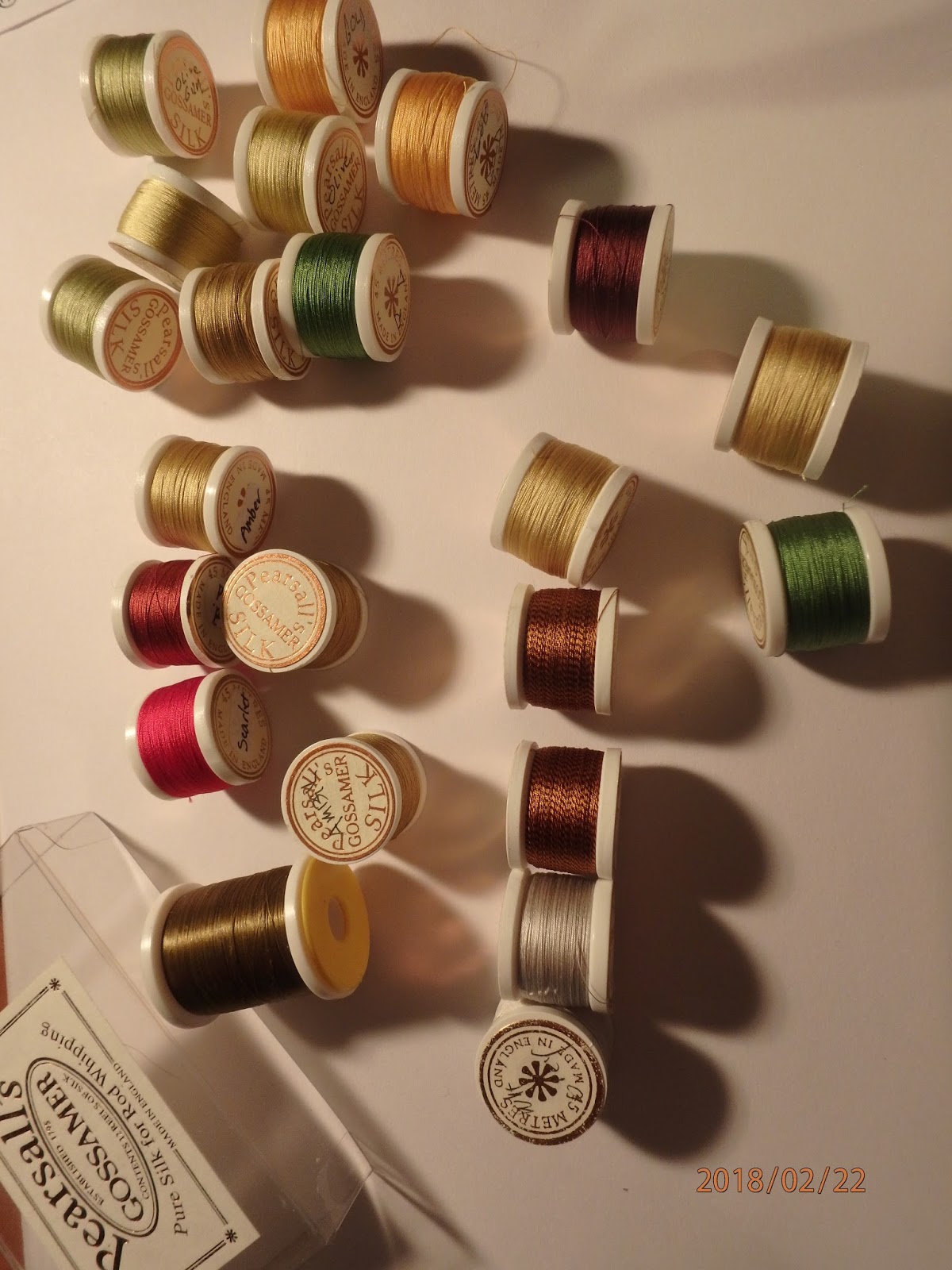
AT left, treasure. It's a pile of Pearsall's silk thread from Lauren at The Painted Trout (link at right), my local fly shop. I suspect it is among the last spools I'll see.

Lauren asked her supplier to "send six of whatever you have in stock." Alas, no purple. One primrose ( I bought it) and a few orange. There are some other colors.

I picked these up Saturday after doing a little morning tying in the shop. Lauren and John helped me label the thread because I can't see the color and have to write it on the spool.

There's nothing here I cannot make work somehow.

I'm going to confess I gave away a couple stockpiled purple and a couple stockpiled orange to a gentlemen angler who is a friend of Lauren and Dirk's and who is a member of Dirk's trout club down in Ohio.

The fellow has tied soft-hackles forever. He thought he had some stockpiled thread. Turns out he didn't. I know how I'd feel if Bushmill's stopped making whiskey.

I bought too much thread (about 3 years worth). I'll use it. I used five spools last year (I save the little spools) so that was a lot of soft hackles. I tied in excess of 500 for sure. I gave a lot away. I'm converting folks.

There were several colors that I've neither seen nor used.


At left, some sort of light color. I thought it was salmon but I have grey written on the spool. Maybe I didn't buy any salmon thread.

Anyway, this very light thread is going to do well for me. I see a lot of twisted strand ribbing out of these two spools. I'll use it for close ribbing over dark thread bodies and have a nice "zebra" effect to test.

I've looked at Steve Bird's wasp/bee pattern for a bit and wonder, is the basic stripe ignored too often? I'll find out.


Some sort of new (to me) metallic sheen silk. Says "brown" on the label where I wrote it. I like it.

We'll see what kind of pattern it makes on a hook shank.


Lastly, this "dark claret" as I've got it labeled is wonderful. It has this translucent lushness when I dip it in water.

I'm going to use this for some ant patterns. I'll cover lashed foam bits with this thread and see how it goes in the end.

Yea, I know. Ants? Like how could you make an ant pattern better. Trout eat them when they see them, mostly.

Ahhh Hah! Let's get rid of that "mostly" business.

Anyway, I'm going to miss the small bobbin and the lovely feel of Pearsall's when it is all gone. I'll probably have to break down and buy a 1000 yard industrial bobbin of it sometime and spool it off on the little guys.

I know. Doesn't sound like a bad idea, does it?

Happy tying.

Prost.

Sunday, February 11, 2018

Presenting Soft-Hackled Flies to Trout


Above: a ginger-palmered soft-hackle fly as a variation on the theme of the Stewart Spider. This fly is tied on a #8 curved-shank streamer hook from Unpqua. That's a tungsten bead-head.  It's a quite a departure from the #16 thread-bodied soft hackle (shown below #16 purple-and-grouse in a micro-wire wrapped body). 


The large bead-head fly is fished as any other soft-hackle might be. Odd enough given its substantial departure from the wonderful classic bits outlined in Robert Smith's wonderful The North Country Fly.

 My underlying premise is that soft-hackle flies are the foremost expression of pragmatic fly design and their manner of presentation is itself an expression of the same pragmatism. 

The soft-hackle anglers pursue what works without dogma or restraint. If it works, it becomes part of the general codex. It's passed along. It's taught. It's imitated. 

If the soft-hackle angler has a motto, it is this: curb your dogma. 

Irreverent? Sure. Successful? You betcha!

A minor digression for the Baked Goods Illustrated crowd. 

Scones this morning. A maple-pecan praline scone. There should be a decadent sticky glaze on these but here at Bear Central, we eat them without embellishment alongside strong coffee. We're not much on the over-sweet in this house.  This batch came out light but satisfyingly rich in flavor. I added a touch of nutmeg and the toasted pecans took to it quite nicely.


Back to fishing: Soft-Hackle Presentations

All of fly fishing is divided into two parts. We fish to trout or more frequently we fish to habitat.

I'd love to assert that I do most of my fishing upstream to rising trout just in that twilight of a quickly-cooling summer's evening. I'm doing well to encounter these magical conditions three or four times a year.

I live in a world of conflicting priorities: a spouse, a mortgage, the day job, the night gig, the love of a trout stream. I get out when I can get out and my rivers are three to four hours away. Like most of you, I fish when I can fish regardless of the hatch, the trout's state of mind, or the weather.

I spend the majority of my time fishing to where feeding trout "ought to be": habitat. 

There's a distinction here of note. I fish to feeding fish. 

My entire approach is based on the premise that I will hook more feeding fish than I will hook from territoriality, aggression response, or  whatever else motivates a trout to jaw a fly when it isn't hungry. Those too are valid approaches. They simply are not my approach.

The techniques I employ target equally a pod of feeding fish or the locations I believe should harbor a pod of feeding fish. I'll change my fly in reference to what I observe. I'll frequently sit on a piece of timber, light my pipe, and glass the water ahead and behind me both looking for clues as to what is going on below the surface. 

The Approaches Employed:

I fish soft hackles as I fish dries, nymphs, or streamers. I'll vary the approach based on conditions and regrettably, most of the time that means the physical condition of the river and where I might be able to stand to cover a bit of water. I've a lot of timber, bramble, and swift current to consider.

The Upstream

I fish soft-hackles on a ten-to-thirty degree angle to the current on an upstream lie. I'm fishing on the surface film, or in the top eight-to-twelve inches, on the top of the middle-third of the water column, or on the bottom one-third of the water column. I can be fishing full-column depending on bug activity.

I'm making short casts following a gentle and silent approach from downstream. Short casts Normally means twenty to thirty feet. This is my favorite approach when I have a chance to fish to a feeding trout. I use it plenty on fishing to habitat but I love watching the take from a feeding trout at close range.  

The fly never drifts downstream of me.

The Up and Across

I'm fishing the entire water column here again. I'll make a reach cast across strong current between my fly and my rod. I prefer not to do so but things are what they are.

I cast thirty to forty-five degrees off the current vector. I'm fishing very short stretches because drag will hit quickly. Sometimes drag is excessive after five feet of drift. Generally I can get a good dozen feet. There's no sense intentionally casting where you see the presentation will be ruined and the fly will look like inanimate detritus slashing through the current in an unnatural fashion.

I again can be fishing full-column depending on bug activity.

The fly drifts downstream no father than my feet or just slightly behind. When the fly drifts this far, it is because I want the recovery and re-cast not to have a chance to bother spotted fish. Otherwise, we're making short casts across the water. taking a step upstream, and repeating. 

The difficulty in controlling a fly makes the upstream move from the  recovery and re-cast productive. 

Attempting to cast and drift over fish while moving downstream will soon produce the arrows of fleeing fish you didn't know were present but which your angling efforts alerted and alarmed.

The Across

Here I am firmly fishing to habitat. I've been limited in my approach because of environmental conditions and casting laterally across the flow is as good as it gets. You read that correctly: the across method is a desperation approach.

I'll cast across perpendicular to the current or slightly upstream. I'm usually fishing the top one-third of the water column. 

This year, I will work on swinging my larger fly through the water "flying" it in the bottom two-thirds of the column more as one fishes to steelhead. I'll have to work before I can report back on that approach.

Here, I'm fishing in the top third and I'm fishing highly motive flies. The hackles are long and "flouncy."

I'll make a reach cast to put an immediate mend in my line. I'll use repeated vertical mends from the famed "greased line" technique. 

I need to manage my mends to control the line and first parts of the floating leader but not jerk the terminal end with the fly attached. This takes control, finesse, luck, and coordination I regret to do not readily possess. Every season I have to spend a couple afternoons re-learning the precise motion that becomes an automatic muscle-memory judgment by June.

I'm watching my tippet. I'm watching it as intently as a tight-line nymphing expert watches his leader's junction with the water. Most of the time, the fish catch themselves. Most of the time. If you give the fish a five count, he will figure out how to spit the hook.

This is an area fishing "the-only-way-to-get-there" type of compromise. I will allow the fly to swing at the end of the coverage and -- timber snags permitting -- I will pursue and actively fish the dangle. I will do this fish-to-the-dangle rarely.

Mostly, I'm fishing to a ten-foot long stretch of water and will fish that water, then move upstream and fish the next bit. I'm not sweeping or swinging. There's a lot going on to keep a good drift but managing that action across one hundred twenty degrees of arc ? No thanks. I'm not that good.

I'm resigned to "as good as it gets" on this one. Short controlled drifts predominate.


The Across and Down

I'm casting forty-five degrees or more down from the current. I'm fishing a tight line at least part of the time. I might be stack mending at the end or I might be using the greased-line repetitive mends as soon as the fly hits the water. 

Most often, this is indeed your grandfather's swing through a broad gentle flow when the water might hold fish but where your reading of the flow gives no immediate indication of where in the flow the fish are concentrated.

I'm fishing in the water column most often here. I'm maintaining at least a frequent direct contract with my fly.

I'm saying a little incantation designed to bring one of those Todd Moen filmed trout thrashing-up out of the water on a super-aggressive hammer take.

I've been known to mess with my gear, pack a pipe, open a beer, eat a cookie and sometimes all of these because it seems to be a fish-inducing sort of action.

Cast. Step. Think about the next more technical piece of water. Cast again, step. Play with the dangle. Step.


The Downstream.

I'm fishing here in the full water column. Hazardous wading has positioned me so that I have to approach a fish or an especially good piece of habitat from upstream.

I'll try and position myself low and about thirty degrees out of the flow line.  I'll cast well upstream of my target and use large lift-mend stack-mend actions to release arm-lengths of line into the flow. I'm watching my tippet.

I'll try to control my drift so that I cause a lift in the soft-hackled presentation at or slightly in front of the likely trout. I'll direct an errant drift down to one side of the trout and us a roll-cast pick-up to lift the fly cleanly from the water downstream of the fish.

Often, I'll do some sort of perry poke type of side delivery after a pick-up to dump the line into the flow well ahead to the trout then I'll work like mad to re-position line and slack in my hand for another go.

I don't read about a lot of success with this technique but I'll say it is deadly for me. 

The key? Innocent eye approach. A trout doesn't have great memory recall. After I make my first approach, I'll recover, reload, then count to at least twenty before trying again.

I've caught trout after seven unsuccessful passes. You wouldn't think you'd get more than one but you do ... if you're cautious.

Yet To Come 

I'll work up illustrations and have a little to say about each presentation here in successive posts. 

Soft-hackles can be actively fished as one would fish any other food imitation or lure. They can be fished in all these techniques successfully. It's the presentation that matters and with a soft-hackled fly, you're on a downstream run to the ice-cream shop as far as presentation goes. The flouncy hackle almost does all the work for you. 

The fly is imbued with the illusion of life. Just don't mess it up.

Sounds like everything else in life.

Thanks for reading

Prost.

Saturday, February 3, 2018

Swing for Trout


For the Baked Goods Illustrated portion of today's entry: blueberry muffins.

George, thinking of you here. I make a respectable cup of tea so if you happen to get over here on this side of the pond, let me know.

I've got berries secreted in the freezer.

Beargirl thought these were so good last Sunday morning ( I  made mini-muffins out of the same batch, too) that I think she's planning on making them for me in the morning. They'll be snow and snow blowing so I'll have muffins after clearing the drive.

Not a bad gig if you can get it.

I've been at the bench. Actually, I've been putting in a great deal of effort on the day job here the past couple of weeks. I've need the stress relief of the vise.

Trout dreams.

Some flies are posted below.

I say that  though really one should read Steve Bird's great pieces on trout spey suitable designs over on the Soft Hackle Journal (link right) and some of Alan's recent numbers at Small Stream Reflections, also linked at the right.

I'm looking forward to more soft hackle swings throughout the water column and less bloody nymphing come ice out. I'm not a fan of nymphing but will, if pressed.. Swing will help my outlook and make me less grizzly on the early water.

On my mind has been the need for a solid selection of soft hackles to use throughout the water column when swinging trout spey and for use with conventional single-hand 5wt, 4wt, and 3wt rods.

Michigan is ideally a 4wt state. 5wt and 6wt outfits are great for serious -- modern Galloup-style --streamer action, mousing, and the great Hex hatch. A twelve inch brown (still above the state average by 4 inches) does well on a 4wt rod.

A 3wt  does fine when the wind is down -- as it is most evenings.

Top Layer: 

Last year at some urging, I tied a few CDC based soft hackles to use in dry-fly season right on the top-water boundary film. These work well. I'll be tying many, many more this year. Dry fly hooks pinched barbless; thread bodies; CDC hackle.

Steve Bird has a class of dabblers he's recently outlined and will be featured in an upcoming article in Swing the Fly (a Magazine I heartily endorse. Get the three-year subscription. It's worth it.) I have to work these up.

Also, there are a class of long-hackled Scottish flies fished dry that are in the same design pattern as wet flies but are finished with soft hackle alone as opposed to Jinglers which seem to have stiff and soft hackles blending our American Catskill dry fly with the traditional loch fly design. I have a Davie McPhail example and will be working it up here in the coming weeks  .


Sub-Surface:

This is the top eight to twelve inches of the stream. Classic soft hackles work great for me here on slightly heavier hooks tied with conventional grouse, pheasant, partridge, India hen neck, and starling hackles. I like lightly dubbed bodies on these flies but "lightly" can take a little work for me. I have to remind myself to use half as much dubbing as I'd want to use on almost every fly.

Mid-Column:

Here I have had some trouble. These are the two-to-four foot depths.

 I've tied lightly weighted soft-hackles (the Coug -- a red floss and herl bodied dun-hackled fly with 4 wraps of non-lead ) with good results for brookies.


I've had less success with browns. I suspect my drift is unduly influenced by the weight. In gin-clear water, the fly clearly moves differently from a natural nymph in the same strata of the water column. Life is insufficiently imitated.

I'm going to  work on managing my "intermediate" drifts more with flouro tippets and light sinking tips. I suspect that "contact drifting" these patterns with just the barest twitch from the twisted-hand retreive will give me the contact necessary to detect subtle takes.

More contact swing from larger size 8/10/12 3xl long flies tied expressly for the swing should also help.

I've used the Gamakatsu T10-6H salmon fly hooks this week to good effect. I like them.

Bottom:

Here, I am going with soft-hackled streamer designs. I'm looking at spade flies (outlined by Steve Bird again) coming from the steelhead side of the house and attached to true sinking tips in seven and ten foot lengths fished on tension.

[New Swing the Fly arrived today specifically discussing the swing under weight from tips. I'll read the article tomorrow morning over coffee. You read the NYT if you want. I'm reading about trout.]

Also, I'm tying soft hackle streamers such as the royal coachman plus a few hairwing patterns I tie so poorly I'm not going to mention them yet.

All in all, I'm satisfied that some techniques such as using dual-hackled heads,  more palmered bodies, and better attention to detail on some adapted Atlantic Salmon hairwing patterns will let me cover the big water and the deep holes.

I'm feeling confident I can relegate nymphing to a secondary effort.

I cannot completely give up the tight-line flymph. Indicator fishing (I like wool tuft indicators) is just not a desired option. I'm done fishing for catfish.

Maybe if I have to fish milkshake waters.

Some flies from this week. These are larger trout spey style flies in size 6, 8 and 10 in 3 xl.

Work to do. Work to do.


Prost.


Saturday, January 20, 2018

Fly Talk: Isonychia, The Drakes


One of the Amber Liquid guys suggested I actually contribute something to the fly fishing codex of our group instead of the "Baked Goods Illustrated" segment.

No cookies for you.

So, Michigan. Let's cover a series of  invertebrates which casual anglers here in the mitten can expect to reasonably encounter in our streams.

I'll start here because the isonychia is one of my favorites; is active as trout food for long stretches of the season; and is found in the types of places anglers love to fish: cobble, boulder, and -- in Michigan -- gravel strewn riffle.

The isonychia is a mayfly.

This genus is common all over the northeast and has a couple sub-species in the Yellowstone area ... though I am not qualified to speak on western insects.

Above, an iso flymph tied today on a new vise. First fly tied on it.

The iso genus has several sub-species. In common names:

  • the Slate Drake (bi-color iso nymph), 
  • the White-Gloved Howdy, 
  • the Lead Winged Coachmen (yes, just like the classic fly pattern), 
  • and the Mahogany Drake.
The slate drake nymph is famous for its "racing stripe" down the middle of its back from head to tail. Unmistakable identification when you find this trait.

The iso is active in the fastest parts of streams. He is a great swimmer dashing from rock to rock within his habitat.

He perches on rocks in the mainstream or just off it with his back legs gripping tightly while his foreparts and forelegs make a basket from which he catches and consumes bits and pieces.

He's in the water actively from May through September in one form or another and crawls to the slower water on the stream's side to emerge.

I make great generalizations here across all the species because they all behave the same. It really isn't too important to know one from another.

He's a dark beastie in the water 12 - 17 mm long. He's longer than your thumbnail, then. Orvis sells an articulated imitation which gives you an idea of the substantial length of the nymph. ( I'd don't find tying two-piece flies fun and I can't imagine anyone else does either).

So ... the iso is about an inch long. He lives in rocks, gravel beds, and on small boulders. He's in the mainstream. Trout see displaced iso nymphs all year long. He lives in large populations on stretches of Michigan rivers like the Au Sable.

Most hatches occur in the late afternoon towards evening. I'm not covering the fishing of the hatch or the spinner here. I haven't had good luck with either beyond normal "throw an Adams at it" so I can't really say much about chasing during the hatch.

I have had good luck swinging iso nymphs into pools at the end of cobble and gravel runs right about dinner time. Think of the stretch below Powerline on the Upper Branch Au Sable.

The fishing is simple: bottom 1/3 of the water column. 

I like a tight-line swing with small jerky tugs of 1-2" as the swing progresses and I know I'm at depth. It helps the hook-ups and helps the imitation as isonychia do have a jerky style of swimming.

I use other means to get the fly down to that level rather than weighting the nymph. I want the nymph to float free as if lost in the current rather than thump along at the bottom mixed in with the bits of organic detritus.

The color is a bit lost on me though Ann Miller says he is reddish-brown to purplish-brown in body. Sounds good.

The fly above is a #10 3xl heavy U205 umpqua hook.

The fly is tied short way above the curve of the hook. That's important for the swing. You'll get aggressive trout dashing up to take the fly and turning quickly back downstream. I think the exposed hook helps. At least, having the fly tied this way has ended some of my frustration at slow strip-sets.

Tail and abdomen: pheasant.5-6 barbs. Trout cannot count how many tails a fly has.

Thorax: Wotton SLF in dark claret sparsely wound and picked until ragged. I use a dubbing loop and get a good ratty twist with it.

Hackle: Barred hen in black, solid brown, or dun grey. Early season, the barred or all-black hackle seems to help. No, I don't know why.

It's a good fly and I'll have three dozen in the quiver before opener.

I lost four in a row on one stretch of the Mason Tract last year. Took a fat brown on the fifth tie. There was a lot of timber partially buried on the South Branch Au Sable last year. More than I remember previously being partially buried mid-stream. Snaggy.


References:

Hatch Guide for Upper Midwest Streams. Ann Miller. pp 116 - 121.
Nymphs. Ernest Schweibert. pp. 204 - 210. (In my 2nd edition with all the corrections).
Mayflies: An Angler's Study of Trout Water Ephemeroptera. Malcolm Knopp and Robert Cormier. pp. 84 - 91.


I'm cleaning up my go-to-stream boxes from all of last season. You should do the same.


Prost.

Tuesday, January 9, 2018

Monday Night Fly

Jim and Brian tying steelhead flies. Lauren in the background talking to another local business owner. Ed is hidden by Brian who is looking at one of his feathers.

We tie on Monday nights at the Beer Grotto in Dexter. It's a way to pass the winter.

Might as well be called the bear grotto.


Wednesday night in the spring will see "casting night" at some local retention ponds. It isn't the fine facilities of the  San Francisco Casting Club but then it's Dexter, Michigan. Snake roll, single spey, the parachute, the steeple. It's a way to get some folks out with rods in their hands and maybe practice some skills that matter in the sorts of places we fish around here.


The all-purpose early-season twin-hackled Jingler.

This Jingler has a sliver of closed-cell foam lashed to its back then wrapped with pheasant tail. Should float all day in dry-dropper rigs.

I tied these Monday night on size 13 and size 15 barbless hooks. This early season version is drab though the rust soft-hackle does a nice job. I'll dub olive and light olive bodied versions here shortly as well as a coachman style afterbody.

We'll see. I tied too few of these last year. I'll tie five dozen this winter.

Show and tell. The is the box of my new 4" Bougle. Nice box.
  The case and reel. Nice leather. I'm going to have Chris Lantzy whip up a utility leather case. The case that came with it is really nice but I want more padding. Chris does a great job with the padding.


Late picture of some of my resident turkey at the "flock block" during Christmas week.


Practicing for season. Hammy-Cheesy biscuits I made for breakfast Sunday. Cathead biscuits with half a cup of shredded Tillamook cheddar and a cup of ham toasted in a skillet added at the final mix.

Even Beargirl thought these were pretty good. At camp, they'll be a huge hit. It's a ham sandwich breakfast style. Goes great with coffee.


Biscuit porn.


Fifty here on Thursday. We'll see if any of the ice on the Huron breaks. My bet is it won't.

Prost.

Tuesday, October 24, 2017

Wax On -- Fine. Wax Off? Maybe Not.

At left, some Bailey's Fly Tyer's Wax.

Yes, that's a small KaBar and it was just sitting on my desk so I used it for a size reference. I wear one when I go trout camping and the library shows a little wear from a hard-run at late-season trout.

There's a story behind this but let me show another picture.


Here's the puck of wax. I removed a piece on the left -- too much -- for a Monday night session here at the Beer Grotto.


I read about the Bailey's Wax--probably named for Dan Bailey-- in an article I found in the magazine FlyFishing & FlyTying as written by Magnus Angus. (Article Here). Mr. Angus does a great job on his review of the product and I encourage you to have a look.

However, you do need to read all of the words. I might not have done that.

This Bailey's stuff is a dubbing wax. Great - I need it for dubbing and if it has sufficient tack (it does) I can use it for my hand-tied whip finishes and never smell the Hard As Nails again on a Sunday morning. (Enough of that you in the peanut gallery).

I sort of ignored the wise words of Mr. Angus about using spirits to remove the stuff from his fingers. Missed that part entirely much to my peril.

The stuff melts if you stick it on your paw. It softens. It also spreads a bit.

Imagine pine tree pitch with a bad attitude from a Christmas tree gathering expedition in your prospective father-in-law's new Mercedes which he has graciously loaned you for the day to take his daughter to get the seasonal pagan symbol.

Oh yea, the stuff went everywhere.

Now, dubbing with the stuff was amazing. I'm a dubbing loop fellow and I've never had such wonderful bottle-brush dubbing spins as when I used a bit to help my dubbing adhere in the early twists (I don't use a weighted little spinner).  There is no comparison between low-tack stick wax and this Bailey's stuff.

Though trying my new wax with a generous dollop--read "too bloody much"-- on my left index finger looked very cool, it rapidly emerged that I might have done something unwise.

A bit of loose dubbing stuck to my finger and I thought "no problem." Then a bit of trimmed deer hair stuck to my paw as I was tying up some Warden's Worry bucktail streamers and had some trimmings on the table.

Then the  hen feathers -- red -- stuck to my fingers as I was using a few barbs at a time to make the tail per the tying example of Joseph Bates in his Streamers & Bucktails. The increasing tackiness of most of my fingers and some of my tools was becoming a problem.

Then my beverage suck to my fingers.

No, not the wax hand fingers. The glass stuck to my other fingers on the hand which didn't even have the wax globbet clinging to it.

Hmm. Time to clean up.

Soap? This stuff laughs at soap. Laughs.

Luckily I was in a bar and there were some "counter grade" spirits readily at hand, as it were.

So, a little goes a long way. Wax that is. I used enough for something like ten tying sessions on my first try.

Advice: a small flake one-half the size of a dime shaved, kneaded, and adhered to a finger  and not a finger joint would be plenty for at least a dozen fully dubbed fly bodies in size six or eight.

The package is wonderful: that's a screw cap aluminum container and the wax is packaged in parchment within.

The wax is completely non-tacky to start. Knead it for ten seconds and place it on the surface of one medium sized bear paw and ... aggressive pine tar resin.

Works great to dub, though. Works great.

It's a tool. Most tools require a bit of knowledge to work well. Bailey's wax falls in that category.

I bought mine from a great guy named Christopher Stewart at Tenkara Bum ((Tenkarabum.com). Awesome service.

I like the stuff. I like what it did for my dubbed bodies.

I still had a bit on the back of my left forefinger this morning sort of matted into the hair; but, I burned it off. Clean now.

Prost.