AT left, a picture from the Neversink well inside the Unique Area looking down on the river itself. In this picture, flows are three times normal as measured at an upstream gauging station. The debris from a couple weeks ago is another six feet up the banks! That must have been something to see.
I took a fish out of the slick in the bottom right corner.
The water had a slight cast -- green, Jim says -- but visibility exceeded 20 feet. I had the head of a Wulff TT line out plumbing the depths off a rock ledge and I could see my bead-head PTN flymph just ticking the bottom rocks as the color transition on the line denoting the head was in my hand.
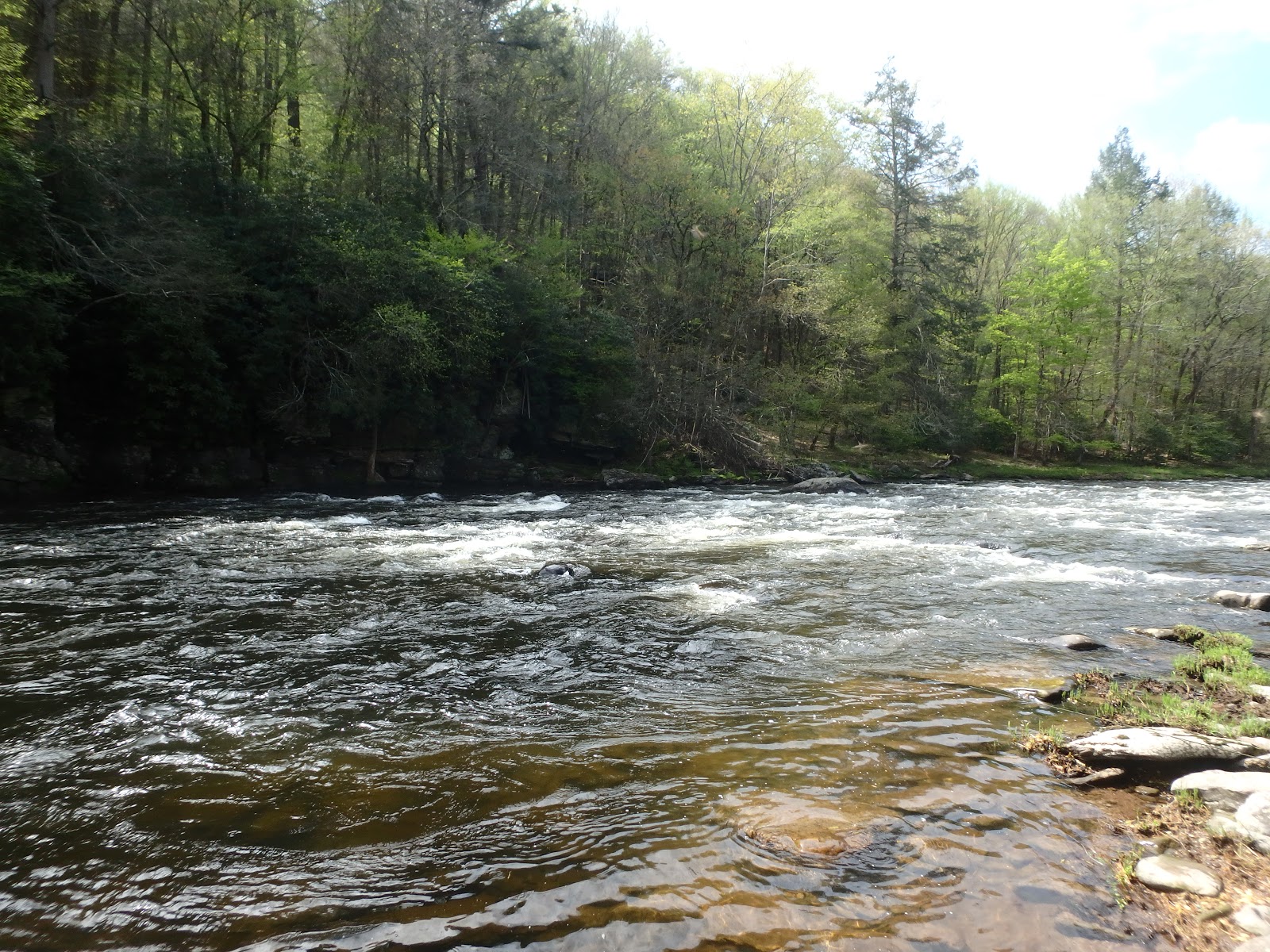
Our lunch spot. Jim in foreground. Riffled break goes up around the bend. A long slick is a my back.
We've hiked in about an hour mostly downhill to reach this spot. The day began with light rain and a cold drizzle and became this warm spring day with full sun. It topped 70 by the time we hiked out.
We were supposed to have storms but none materialized. We could hear thunder in the north as we hiked out.
The downstream lunch view. Halfway down a brook emerges from behind Jim.
The humidity was up: tropical, even. The river valley was set to "coastal".
The blackflies were out in hordes. We endured though I'm covered in small itchy welts. Mildly annoying at the time. Mildly annoying now.
Black flies are not deer flies and the bites are in the "discomfort" range. Deer flies are far worse.
The small brook in its last pool before tumbling to the Neversink.
It is water very much like Alan fishes on Small Stream Reflections in the right sidebar. The little fellow ran full but the very steep plunges seemed to dissuade the brookies.
I tried a Wulff in size 18 here. Nothing rose. My suspicion is that my over zealous approach put the fish down. Has to be one in there.
This lovely fellow in the 16" - 18" class (net holds a 21" when stretched so I have a good comparison) came from the foot of the flow where the brook (above) runs into the Neversink.
This was a very quick in-net photo and the lens is slightly fogged from being in my shirt pocket in this very high humidity. I'm standing one foot in the brook looking out to the river.
He lacked girth but was long like a cat stretched out on your leg. I frequently encounter cat-on-leg so it comes to mind readily.
He took a partridge-and-yellow in size 12, wire wrapped with a piece of .20 non-lead tied-in along the shank. It sank well and I had to guide it downstream about sixty feet from where I could stand in the brook in order to clear some car-sized submerged rocks.
The fight to get him to my net was as exciting as I've had in years. Current, strong fish, rocks. My heart was pounding and my smile hurt my cheeks.
The emergence point of the small brook featured above. That current tongue on the right which meets a poorly illustrated lateral seam from the Neversink proper was just where I caught the trout.
I took my snapshot, declared my prize, and moved on to let Jim have a shot at what clearly was a wonderfully fish-y spot.
The lunch spot riffle-run. The high water and fast current induced standing waves I don't suspect are standard on the Neversink.
A line of riffles from submerged rocks running across to the rock bluff just coming into view on the far left of the frame. It is much prettier in person than the flattened perspective of a snapshot allows.
The seam 1/3 the way across the river held a deep pool and it yielded a nice trout.
An 8" - 10" class trout from the bottom of a Neversink pool. Lovely coloration on this guy. He received a quick lift -- tail still in the stream -- for the snap.
I like this method of photographing fish as he was exposed to air for less than a five-count. It isn't the best fish picture in the world but we've all seen fish and he could use a break.
I've enough "grip-and-gin" for a lifetime.
He's kinda cute in this one.
I fished a Hardy 8' 4wt Zephrus with a Douglas 3" Argus reel and a Wulff TT line in 4. The high water really made the aggressive roll cast the means of fishing. The 4wt was fine for the day.
The Neversink in the Unique Area is really good cane water. The early drizzle and the threat of storms made me bring plastic. I have a nice 8' 4/5 Steffen Bros. fiberglass blank laid up by Mark McKellip but I grabbed the Hardy because I wanted to see how it did with dry-fly in the field. New rod from the winter purchases.
Alas, we saw a half-dozen risers but couldn't reach across the river to get to them. My 6wt Winston Boron III Plus I used on the Beaverkill would have allowed me to make the presentation but I suspect -- correctly -- the rod to be overkill for the standard trout in narrow confines.
A four weight gave me thrills on the large fish and enjoyment with the smaller. Lots of bugs off the water; but, little surface action.
I tried the litany of soft hackles -- some dressed to the film, others in the top 8" or so and a few lightly weighted with wire wraps for the top 18"-24". Nothing.
I lost several fish on long lines fishing deep swings with weighted black, orange, and a couple snipe and purple soft-hackle flymphs tied with tungsten beads in #14 and #16. I used a long-line nymphing technique (no bobber) and a long leader greased at the junction with the fly line. I could hook-up using the barbless ties even in strong currents with a lot of line. I only brought one of these to hand however.
The fish in the net above took a cdc caddis in grey drowned by a current tongue and carried nearly across the bottom of a pool. I could see the flash of the take.
The current was too high for wading as pictured. We fished from the banks and a few rock-hops.
From the hike through the forest.
The Neversink Unique Area is well worth the hike. It's easy to find a day's worth of water and we saw no other anglers. A mile on foot seems to be the measure that sorts the crowds.
In the increasingly crowd-fished Catskills, the Neversink offers the isolated adventure one needs.
Prost.
A nice stain on the water, a nice stain on the beverage. Coincidence? We think not.
Showing posts with label flies. flymphs. Show all posts
Wednesday, May 15, 2019
Monday, May 13, 2019
The Beaverkill Pools
The core of my Catskill trip revolved around "the five" : west and east branches of the Delaware, the Beaverkill, the Willowemoc, and the Neversink.
These five constitute a career's worth of water. If one were to fish no other streams, there would be enough here for fifty years and a dozen styles of fishing from wispy two-weight dry fly midges on tiny brooks to true Spey-style swings for deep-holding large trout across massive waters.
Our style of dry fly fishing here east of the Mississippi originated in flies inspired by those sent by Frederic Halford to Theodore Gordon. Gordon slightly altered the appearance of some patterns to more closely resemble those of insects hatching in the Catskill system illustrated at left and thus began the "Catskill-style" fly fishing of surface dries.
Certainly there were independent origins of dry fly development and the products likely evolved into the synthesis of what we consider now; but, the spiritual heart of the dry fly emerged and was re-enforced by the presence of writers and their east coast readership who had the means and leisure to pursue fly fishing in this region. Other factors for fame include the introduction of brown and rainbow trout into brook trout fisheries decimated by deforestation and over-fishing.
Today I want to speak of the classic pools of the Beaverkill. My hand drawn map at the above is an inexact approximation; but, as you look at it, we're dealing with the section in the middle from East Branch upstream on the Beaverkill to Roscoe where the Beaverkill is joined by the Willowemoc adding a considerable amount of water to the flow.
The famous pools begin inside the town of Roscoe on its southwest side with Junction Pool. The river and its pools are paralleled by Old Highway 17 throughout this length which makes the park-and-fish angler its principal population but for a couple of locations.
New Highway 17 (4-lane divided highway) is seldom out of sight and less out of earshot. There is little illusion of fly fishing classic waters from the early 1900's in the presence of singing tires and jake brakes from tractor-trailer rigs slowing on curves.
The pools are easy to find for they all bare large signs. Here is Junction Pool's:
We're in town at Roscoe. I'm standing on a bridge abutment. There is a smallish parking lot here with room for half-a-dozen cars. The Roscoe Motel is across the road just behind me and to the right.
And, the pool. That's new Route 17 in the background. There is some sort of light industrial building across the river separated from the bank by a large chain-link style fence. The rip-rap on the bank is natural stone but still appears to be dumped by a highway department probably after the erosion caused by the massive flood of 2006.
Anglers fish this stretch rod to rod standing on the shallow inside from where my picture is staged and casting to the channel passing by the far bank. Only one angler was fishing when we arrived -- a rare occurrence -- but the whole place had the air of "fish harvest." All that was missing was a large salmon trap floating against the bank with its arms slowly turning to the cadence of the harvesting march. (Sounds a bit like Panzerleid to me).
The aroma of combat fishing hung too strongly in the air. We passed and moved along.
The pools on the Beaverkill are close together and flow one into another. Below the Junction Pool is Ferdon's Pool named for the Ferdon family. Oddly, it is this pool where the first Hendrickson fly was tied by a guide named Roy Steenrod for the famous Mr. Hendrickson for whom the Hendrickson Pool is named. All very confusing, I'll admit.
Below the Ferdon's Pool is Barnhart's pool. Sign at left. Pool pictured below.
That's Neall from the Painted Trout on the bank. My other pictures turned out poorly. It's a pool of water reached by a hike of a quarter mile or so across flat -- and sometimes a little muddy -- meadow. There is room for four or five anglers here if they know one another.
The Famous Hendrickson Pool. I took a couple fish here. The rocks are brutal. B.R.U.T.A.L.
I'd say you must have a staff here. The current was assertive but the footing was treacherous with rocks distributed across the bottom ranging from basketball to ottoman sized. And ... they move.
I twisted an ankle bad enough I'm still limping here a week later. I just taped it up at fish camp and continued fishing. You might be a strong wader and able to avoid trouble. I didn't. The folks that fished this water one hundred years ago must have been tough.
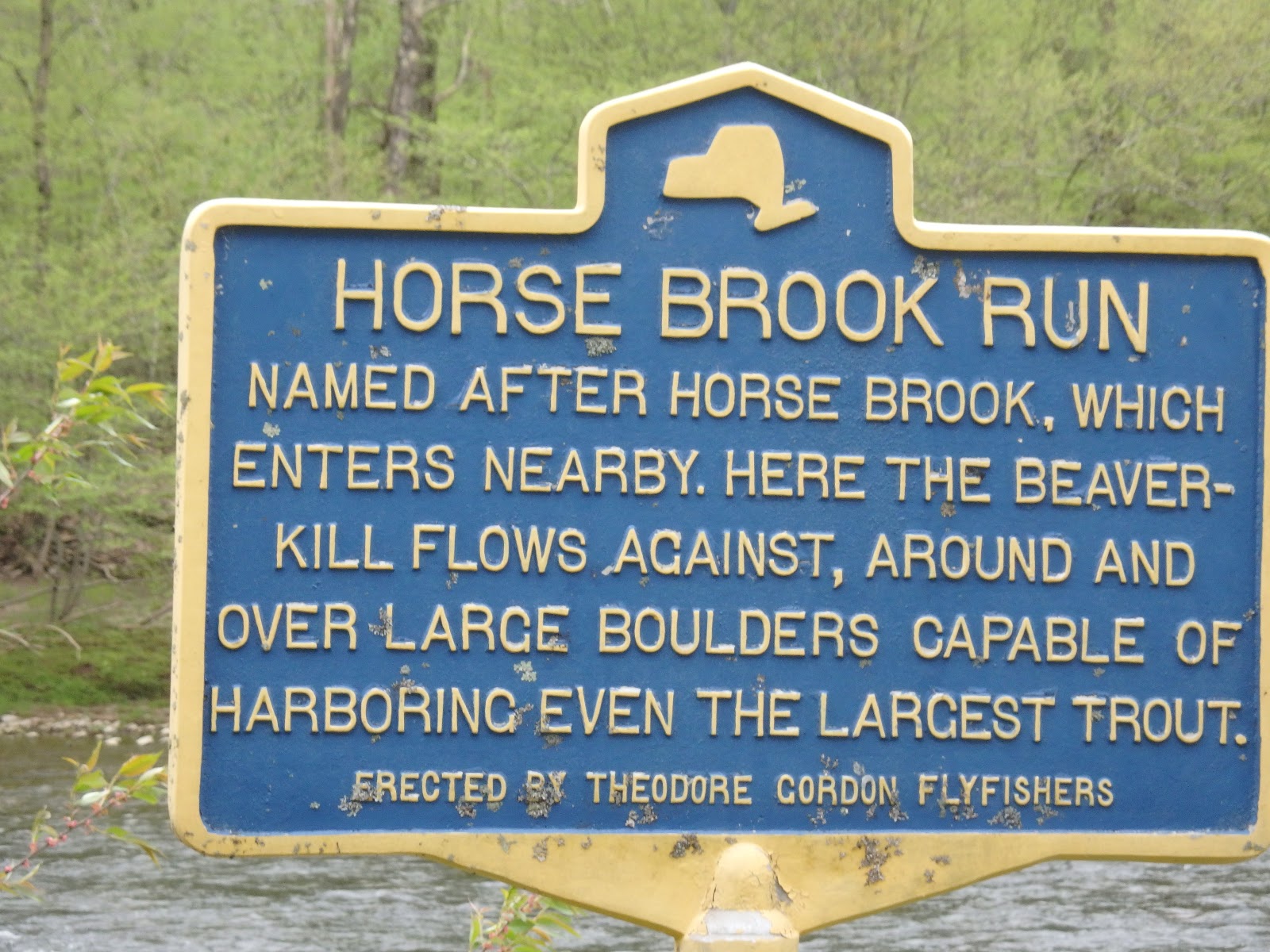
Hendrickson's Pool above on the far left side of the snap as we look down the long flow and the bend toward Horse Brook Run named for Horse Brook which enters halfway down from the right side of the frame. That is old RTE 17 running down the right. The bank is thirty feet of rip-rap and is steep.
Horse Brook.
Beadhead flymph of the type I used to take my two trout in two hours from Hendrickson's. The body of these is a black or root beer dubbing spun in a loop to form a thorax, a hen pheasant tail, and a substantial dark hackle below the bead. The fly is a size 10 1 xl. I lost many in the pinch-points between the irregular rocks. I did however take fish. No one else did.
Stonefly? Iso? Leech? The fly worked.
I asked the trout. They wouldn't talk. Probably knew I was a softie and was going to be quick returning them to the stream.
There are a number of successive pools one after another denoted with signs and located right along the old highway.
We stopped and fished after passing the other pools all of which were occupied by anglers in early afternoon. Painter's Bend just above Cooks Falls presented a nice flow and a nice rainbow for my fishing partner Jim Page.
Jim playing a rainbow.
Wading was much better here. The depth across the pool is mid-thigh with a few slightly deeper slots. Jim is on a cobble tongue so is in a little less water.
The current was stiff but the low depth made it fine to fish. I swung everything in the arsenal a little upstream from here and found nothing. From the riffles below Jim is a section of more than a mile of pocket water. When it is warmer, I'll go back to pick these pools at dusk. My ankle was tender so a great deal of movement in the stream was not high on my list of activities when this snap was taken. I was pretty much just "icing" it in very cool water and practicing my single-handed Spey technique.
I fished a Winston BIII Plus saltwater rod in 9' 6 wt here on the Beaverkill and that was about right. I used a Cascapedia rigged with OPST running line, heads, and tips. With the current, a fourteen inch trout put up a solid fight with fifty feet of line out up at Hendrickson's Pool. Here at Painter's, I didn't think a four weight had enough for control.
A conventional nine foot five was probably right but I wanted to use the Winston.
The panorama of Painter's gives some idea of the course of water. There is a great deal of it here and a party of five or six could easily fish without being in each other's way providing again that they know each other.
In a day, we stopped at five pools; drove past a half-dozen more occupied by anglers; and enjoyed the river immensely. This little section of the "upper no-kill" on the map could take an entire season to learn to fish. There are a great many anglers in the Catskills. There is water to hold them.
My favorite sign from the trip is above.
If you are curious, I recommend Fly Fishing the Beaverkill by Eric Peper and Gary LaFontaine (The Lyons Press. Guilford, Connecticut. 1999). This slim book prepared my crew well for the Beaverkill and the famous pools including bits of the area's history and the naming sources.
Our crew which included two guides and a North American manager for a major fly fishing gear manufacturer struggled at times. Our party had over 250 years of fly fishing time and still the fish were a little tight-lipped. I felt fortunate to get two fish this day. The professionals were blanked -- different water, though.
The fishery is changing. Guide boats have exploded in the past ten years. At one point, we counted nine boats in a line on a stretch of the Delaware. I heard a story of nineteen trailers at a take-out.
Now, I'm not too anxious to pay $400 to follow another boat all day pool to pool. YMMV.
There are no boats on the famous stretch of the Beaverkill. At lest, there are no boats that would last a season or that wouldn't have to be pulled over humps in the case of rafts. This is wade fishing territory and the better for it.
The fish in the pools I covered above see a great many flies.
Like the Au Sable here in Michigan, fish are moving more and more towards nocturnal feeding. They've had dries, bobber-nymphs, and bank-pounding streamers thrown at them. They're responding.
Three fish constitute a fine day on most of this famous water. A decade ago, you'd expect three in an hour. I've never been much of a numbers guy. I like to catch fish but am content with any fish for my effort. Considering I was sight fishing new water, I'm more than happy with a couple of fish taken in spring from the bottom third of the water column.
I saw a handful of splashy rises, surmised subsurface feeding based on rise form, and pursued. My soft hackle efforts in the top third produced nothing. Jim took a rainbow on a nice soft-hackle hare's ear flymph.
You pays your money. You takes your chance.
Prost.
These five constitute a career's worth of water. If one were to fish no other streams, there would be enough here for fifty years and a dozen styles of fishing from wispy two-weight dry fly midges on tiny brooks to true Spey-style swings for deep-holding large trout across massive waters.
Our style of dry fly fishing here east of the Mississippi originated in flies inspired by those sent by Frederic Halford to Theodore Gordon. Gordon slightly altered the appearance of some patterns to more closely resemble those of insects hatching in the Catskill system illustrated at left and thus began the "Catskill-style" fly fishing of surface dries.
Certainly there were independent origins of dry fly development and the products likely evolved into the synthesis of what we consider now; but, the spiritual heart of the dry fly emerged and was re-enforced by the presence of writers and their east coast readership who had the means and leisure to pursue fly fishing in this region. Other factors for fame include the introduction of brown and rainbow trout into brook trout fisheries decimated by deforestation and over-fishing.
Today I want to speak of the classic pools of the Beaverkill. My hand drawn map at the above is an inexact approximation; but, as you look at it, we're dealing with the section in the middle from East Branch upstream on the Beaverkill to Roscoe where the Beaverkill is joined by the Willowemoc adding a considerable amount of water to the flow.
The famous pools begin inside the town of Roscoe on its southwest side with Junction Pool. The river and its pools are paralleled by Old Highway 17 throughout this length which makes the park-and-fish angler its principal population but for a couple of locations.
New Highway 17 (4-lane divided highway) is seldom out of sight and less out of earshot. There is little illusion of fly fishing classic waters from the early 1900's in the presence of singing tires and jake brakes from tractor-trailer rigs slowing on curves.
The pools are easy to find for they all bare large signs. Here is Junction Pool's:
We're in town at Roscoe. I'm standing on a bridge abutment. There is a smallish parking lot here with room for half-a-dozen cars. The Roscoe Motel is across the road just behind me and to the right.
And, the pool. That's new Route 17 in the background. There is some sort of light industrial building across the river separated from the bank by a large chain-link style fence. The rip-rap on the bank is natural stone but still appears to be dumped by a highway department probably after the erosion caused by the massive flood of 2006.
Anglers fish this stretch rod to rod standing on the shallow inside from where my picture is staged and casting to the channel passing by the far bank. Only one angler was fishing when we arrived -- a rare occurrence -- but the whole place had the air of "fish harvest." All that was missing was a large salmon trap floating against the bank with its arms slowly turning to the cadence of the harvesting march. (Sounds a bit like Panzerleid to me).
The aroma of combat fishing hung too strongly in the air. We passed and moved along.
The pools on the Beaverkill are close together and flow one into another. Below the Junction Pool is Ferdon's Pool named for the Ferdon family. Oddly, it is this pool where the first Hendrickson fly was tied by a guide named Roy Steenrod for the famous Mr. Hendrickson for whom the Hendrickson Pool is named. All very confusing, I'll admit.
Below the Ferdon's Pool is Barnhart's pool. Sign at left. Pool pictured below.
That's Neall from the Painted Trout on the bank. My other pictures turned out poorly. It's a pool of water reached by a hike of a quarter mile or so across flat -- and sometimes a little muddy -- meadow. There is room for four or five anglers here if they know one another.
The Famous Hendrickson Pool. I took a couple fish here. The rocks are brutal. B.R.U.T.A.L.
I'd say you must have a staff here. The current was assertive but the footing was treacherous with rocks distributed across the bottom ranging from basketball to ottoman sized. And ... they move.
I twisted an ankle bad enough I'm still limping here a week later. I just taped it up at fish camp and continued fishing. You might be a strong wader and able to avoid trouble. I didn't. The folks that fished this water one hundred years ago must have been tough.
Horse Brook.
Beadhead flymph of the type I used to take my two trout in two hours from Hendrickson's. The body of these is a black or root beer dubbing spun in a loop to form a thorax, a hen pheasant tail, and a substantial dark hackle below the bead. The fly is a size 10 1 xl. I lost many in the pinch-points between the irregular rocks. I did however take fish. No one else did.
Stonefly? Iso? Leech? The fly worked.
I asked the trout. They wouldn't talk. Probably knew I was a softie and was going to be quick returning them to the stream.
There are a number of successive pools one after another denoted with signs and located right along the old highway.
We stopped and fished after passing the other pools all of which were occupied by anglers in early afternoon. Painter's Bend just above Cooks Falls presented a nice flow and a nice rainbow for my fishing partner Jim Page.
Jim playing a rainbow.
Wading was much better here. The depth across the pool is mid-thigh with a few slightly deeper slots. Jim is on a cobble tongue so is in a little less water.
The current was stiff but the low depth made it fine to fish. I swung everything in the arsenal a little upstream from here and found nothing. From the riffles below Jim is a section of more than a mile of pocket water. When it is warmer, I'll go back to pick these pools at dusk. My ankle was tender so a great deal of movement in the stream was not high on my list of activities when this snap was taken. I was pretty much just "icing" it in very cool water and practicing my single-handed Spey technique.
I fished a Winston BIII Plus saltwater rod in 9' 6 wt here on the Beaverkill and that was about right. I used a Cascapedia rigged with OPST running line, heads, and tips. With the current, a fourteen inch trout put up a solid fight with fifty feet of line out up at Hendrickson's Pool. Here at Painter's, I didn't think a four weight had enough for control.
A conventional nine foot five was probably right but I wanted to use the Winston.
The panorama of Painter's gives some idea of the course of water. There is a great deal of it here and a party of five or six could easily fish without being in each other's way providing again that they know each other.
In a day, we stopped at five pools; drove past a half-dozen more occupied by anglers; and enjoyed the river immensely. This little section of the "upper no-kill" on the map could take an entire season to learn to fish. There are a great many anglers in the Catskills. There is water to hold them.
My favorite sign from the trip is above.
If you are curious, I recommend Fly Fishing the Beaverkill by Eric Peper and Gary LaFontaine (The Lyons Press. Guilford, Connecticut. 1999). This slim book prepared my crew well for the Beaverkill and the famous pools including bits of the area's history and the naming sources.
Our crew which included two guides and a North American manager for a major fly fishing gear manufacturer struggled at times. Our party had over 250 years of fly fishing time and still the fish were a little tight-lipped. I felt fortunate to get two fish this day. The professionals were blanked -- different water, though.
The fishery is changing. Guide boats have exploded in the past ten years. At one point, we counted nine boats in a line on a stretch of the Delaware. I heard a story of nineteen trailers at a take-out.
Now, I'm not too anxious to pay $400 to follow another boat all day pool to pool. YMMV.
There are no boats on the famous stretch of the Beaverkill. At lest, there are no boats that would last a season or that wouldn't have to be pulled over humps in the case of rafts. This is wade fishing territory and the better for it.
The fish in the pools I covered above see a great many flies.
Like the Au Sable here in Michigan, fish are moving more and more towards nocturnal feeding. They've had dries, bobber-nymphs, and bank-pounding streamers thrown at them. They're responding.
Three fish constitute a fine day on most of this famous water. A decade ago, you'd expect three in an hour. I've never been much of a numbers guy. I like to catch fish but am content with any fish for my effort. Considering I was sight fishing new water, I'm more than happy with a couple of fish taken in spring from the bottom third of the water column.
I saw a handful of splashy rises, surmised subsurface feeding based on rise form, and pursued. My soft hackle efforts in the top third produced nothing. Jim took a rainbow on a nice soft-hackle hare's ear flymph.
You pays your money. You takes your chance.
Prost.
Sunday, April 21, 2019
The Hope in a Brook Trout
At left, an over-hackled Hornberg. This is tied on a 12 2XL dry fly hook.
I will use this fly and its cousins in the Catskills here in a couple weeks. I can't wait to try them out.
They are truly unfaithful Hornbergs. I do however like them.
We'll see what the brook trout say, It's the only way to be sure.
Season opens here for me next Saturday. I am camping for trout. I spent this evening assembling the camping gear.
I'm at the cusp of spring with dogwoods starting to bloom, the daffodils in the yard up through a new layer of mulch, and much of the world unchanged from my boyhood.
Chaos. Distrust. Dislike. Hatred. Dissent.
We say these words but they're inadequate. We're animals. We're vicious animals.
Mind, we bite.
There ought to be a billboard out in space warning potential visitors of the fact.
What I enjoy is the promise of the new season. I look forward to solitude and companionship on the water both. I look forward to another summer of campfires, fine scotch, and a pipe. I look forward to the brook trout in my net because it is always a surprise when I manage to land a trout. Every time: a surprise.
What we talk about when we talk about the trout.
For me, it's the hope that I never stop being amazed by the little things as unimportant as a fish in the net and that in the end, I might see past other things that I think are important but which in fact are not.
I know the joy of trout in my net and that the whole operation from the cast, to the hook up, to the stumbling play of the fish to just within my reach is the same emotional base as with the women in my life I've come to love.
It makes me think the whole art of catching was the fish's idea: an incredibly absurd perspective.
No reasoned creature would sacrifice itself in sport just to give a moment's happiness to another not knowing if the end was the frying pan, or a release back into the stream.
I've been tying.
A nice little #16 fat body flymph in olive.
Another olive this time wire-wrapped and wearing dry fly hackle.
A sparse olive passing for a Hendrickson (waxed and thus my light changed significantly) also wire wrapped but with the hackle of a north country spider.
May all your trout be fat and happy.
Prost.
I will use this fly and its cousins in the Catskills here in a couple weeks. I can't wait to try them out.
They are truly unfaithful Hornbergs. I do however like them.
We'll see what the brook trout say, It's the only way to be sure.
Season opens here for me next Saturday. I am camping for trout. I spent this evening assembling the camping gear.
I'm at the cusp of spring with dogwoods starting to bloom, the daffodils in the yard up through a new layer of mulch, and much of the world unchanged from my boyhood.
Chaos. Distrust. Dislike. Hatred. Dissent.
We say these words but they're inadequate. We're animals. We're vicious animals.
Mind, we bite.
There ought to be a billboard out in space warning potential visitors of the fact.
What I enjoy is the promise of the new season. I look forward to solitude and companionship on the water both. I look forward to another summer of campfires, fine scotch, and a pipe. I look forward to the brook trout in my net because it is always a surprise when I manage to land a trout. Every time: a surprise.
What we talk about when we talk about the trout.
For me, it's the hope that I never stop being amazed by the little things as unimportant as a fish in the net and that in the end, I might see past other things that I think are important but which in fact are not.
I know the joy of trout in my net and that the whole operation from the cast, to the hook up, to the stumbling play of the fish to just within my reach is the same emotional base as with the women in my life I've come to love.
It makes me think the whole art of catching was the fish's idea: an incredibly absurd perspective.
No reasoned creature would sacrifice itself in sport just to give a moment's happiness to another not knowing if the end was the frying pan, or a release back into the stream.
I've been tying.
A nice little #16 fat body flymph in olive.
Another olive this time wire-wrapped and wearing dry fly hackle.
A sparse olive passing for a Hendrickson (waxed and thus my light changed significantly) also wire wrapped but with the hackle of a north country spider.
May all your trout be fat and happy.
Prost.
Friday, April 12, 2019
Trout Dreams
You know the ones.
It's morning and the camp coffee is in your hand. You poured it from the percolator that is now beside the hat-full of fire someone started from last night's coals.
There's a light drizzle on and it is cool but in the dream, you're dry and toasty from the bed quilt at home. Camp seems the half-dawn stage between the early crew and the late-abed: the midlands of dreamtime.
You might stroll down the river lane from camp where one or two of your buddies are already on the water. Sometimes you hear them calling to one another as barking dogs in the distance.
The river's surface is dimpled with the tiniest drops from the misty bits and fish are rising. Lots of fish are rising.
Your buddy calls up in a voice filled with smile that they're taking whatever it was you were tying last night. Your flies. They're taking just your flies.
That's a great dream. Sometimes I get to the river with a rod in one paw and a biscuit in the other. Sometimes, just the coffee. Still, great dream.
Size 17 Bear Paw Adams in the vise. The head on this one is off-sized because I broke the thread on the final wraps and had to remediate. I think the large head helps anyway.
He's bushy, floats like a cork, and trimmed below the hook gap sits nicely in the film from the beginning making a moire pattern which is a trick in drawing up the fish.
I love a good coachman -- the herl, you know -- but the Bear Paw Adams (tied with all the grace of a bear paw) is a buggy fly that worked fine for me three years ago and so is again gracing my box.
A guide friend looks at 'em and says "Kinda fat ..." in a restrained sort of appraisal. The over-sized hackle (hackle gauge? Pftttth,), tubby dubbing job, general displacement of a medium-sized frigate, and aerodynamic properties of a penguin are all elements of charm.
His flies only ever look like the ones in pictures and he whips the bastards out even in size 17-18 with astonishing speed.
The perspective of professional fishermen comes close to the fashion magazine effect: no woman looking at a fashion magazine ever feels good about herself next to those beauties.
I say it's all the better those women in magazines aren't real. Like the ancient Greeks, we'd be pushing off too many warships from the shore in the morning to have time for important things.
Like lazy trout dreams.
Prost.
Sunday, December 30, 2018
2019 - The Year of Streamers
At left, a palmered-style bead-headed rusty streamer in #10 1 xl. I've had good fortune with these palmer-hackle flies because they are most forgiving to tie: in the water the hackle covers all manner of sins.
The bead-head I feel now is a mistake. Weight interferes with the lifelike action. A weighted leader and an unweighted fly on a loop makes a better presentation. Head-weighted flies are "lumps" at current speeds I fish never twitching or oscillating. They plunge.
I loved fishing my soft hackles. In 2018, my most effective technique in Michigan involved the long drift downstream. I used this technique of a slack drift past cutbanks, in front of downed timber, and in the inner edge (towards the middle of the stream) current flows that come from major obstructions.
My drifts didn't drag exactly but they produced enough irregularity that they simulated life in a struggling invertebrate and drew fish out of concealed lies.
Unfortunately, I fished to too few actual fish in 2018. I have only one note on stalking and taking a feeding trout. I fished to habitat.
SO, 2019: The Streamer.
I like feeling the take.
I like fishing micro-streamers imitating various baitfish in #5 down to #16 fry. They cast well using single-handed spey techniques.
I like tying the streamers.
I need to learn a little more. I'll look through my copy of McClane's and dig about online for some Carrie Stevens' patterns. I have Sharon Wright's tremendous Tying Heritage Featherwing Streamers but lack much in the way of hairwings in my personal library. I expect I'll be investing in the writing of Joseph Bates.
I'm looking for solid mid-size fish this year: just the chunky 12" kind. I'm told from my reading that many fish in this league transition from invertebrate diets to more piscivorous pursuits. I haven't found such references in the academic studies yet. I'll keep looking. I have reason to doubt.
Nevertheless, in the winter sessions I'll be going through bucktail and spun this and that. I'll make generous use of the over-hackle dressing for heads because I am convinced that the hydrodynamics of a prey animal is considered by a predator.
I'll have fun and in the spring, I'll flip micro-streamers along the banks and under sweepers seeking the hungry ice-out fish.
I'm really looking forward to tying fuzzy-bodied soft-hackle streamers. I'm getting my body taper technique down pretty well.
I hope the trout appreciate that effort.
Happy 2019.
Prost.
Sunday, April 22, 2018
Pre-Season Jitters
I call it stress tying. You know: that period between when you really want to be on the water and when the season opens. That's stress tying season.
At left, a highly buoyant Coachman. I've concealed a strip of closed cell foam down his spine.
Yea, looks like it too. Call it a Royal Porkman fly.(well, need some true white and ...)
My size 17 BWO soft-hackle. Yes, I have a ton of CDC soft hackles in five (!) colors lined up ... not that I have a clue on the colors. I can't see color so I have no idea why I even bother. Usually, I can remember if I sort my fly box which is where. With five colors all tied on a snowy Saturday in January, I've no chance at all.
Nevertheless, a soft-hackle BWO. Yea, I'll work on it. #17 though. With the right presentation it will work.
Soft hackle hare's ear flymphy tung-head.
I might need 'em and so I tied 'em. I am not a real fan of contact nymphing. Yes, I can freestyle nymph pretty well. Yes, I'm always rusty on the first outing. Always.
Why is that?
Anyway, I might need something if it is cold and dreary and my fish want something ticking on bottom.
That's not going to be my opener, though.
I've got a bug up my ass about making a couple epic trips this year.
I'm going to Wabakimi and one never knows if it might be my last trip. One of these days, I'll be flying in to spread some of Mike's dad's (also know as Old Guy) ashes in lower Wabi. He stopped going when he turned 80 and couldn't pack his own gear. He didn't need to pack gear at all but you try telling that to one of those old hard as nails bastards. Go ahead. I dare you.
Anyway, one day I'll be flying-in to spread Old Guy's ashes.
Then I'll be flying in to spread Mike's. We've had some of the best days of our lives sitting in aluminum islands on a place damn few people ever go. I love the Ontario wilderness. Stunning.
I fell in love with Wabakimi on my first day there in a boat with Reagan. His last Canadian trip at 78. My first. Thank you Reagan, where ever you are.
I want the Amber Liquid guys to have this joy. Now, I'm too much of a hard-ass and an asshole-first-class for these fellows to listen to me. Different lives.
Nevertheless, I want them all to know "epic."
Yellowstone offers some of that. I want them to go to Yellowstone.
I want the Lamar. The Yellowstone. The Madison. The Gallatin. The Firehole. Cache creek. Soda Butte creek. Slough creek. The Gardner. There is a decade of fishing there for me.
There's a decade of fun for them. How many evenings around campfires are wasted evenings?
None.
No worries about bears. We share the same temperament. Best to give us both a wide birth.
Opener is next week. I'm building a heavy camp. I'm feeding breakfast. I'm fishing. I'm thinking good thoughts about the fellows who can't make it. Who knows how long any of us might have?
I miss my buddy Dean every week. Maybe I can get Mike to come to Yellowstone, too. I won't let him fish with leeches. I promise.
Prost.
At left, a highly buoyant Coachman. I've concealed a strip of closed cell foam down his spine.
Yea, looks like it too. Call it a Royal Porkman fly.(well, need some true white and ...)
My size 17 BWO soft-hackle. Yes, I have a ton of CDC soft hackles in five (!) colors lined up ... not that I have a clue on the colors. I can't see color so I have no idea why I even bother. Usually, I can remember if I sort my fly box which is where. With five colors all tied on a snowy Saturday in January, I've no chance at all.
Nevertheless, a soft-hackle BWO. Yea, I'll work on it. #17 though. With the right presentation it will work.
Soft hackle hare's ear flymphy tung-head.
I might need 'em and so I tied 'em. I am not a real fan of contact nymphing. Yes, I can freestyle nymph pretty well. Yes, I'm always rusty on the first outing. Always.
Why is that?
Anyway, I might need something if it is cold and dreary and my fish want something ticking on bottom.
That's not going to be my opener, though.
I've got a bug up my ass about making a couple epic trips this year.
I'm going to Wabakimi and one never knows if it might be my last trip. One of these days, I'll be flying in to spread some of Mike's dad's (also know as Old Guy) ashes in lower Wabi. He stopped going when he turned 80 and couldn't pack his own gear. He didn't need to pack gear at all but you try telling that to one of those old hard as nails bastards. Go ahead. I dare you.
Anyway, one day I'll be flying-in to spread Old Guy's ashes.
Then I'll be flying in to spread Mike's. We've had some of the best days of our lives sitting in aluminum islands on a place damn few people ever go. I love the Ontario wilderness. Stunning.
I fell in love with Wabakimi on my first day there in a boat with Reagan. His last Canadian trip at 78. My first. Thank you Reagan, where ever you are.
I want the Amber Liquid guys to have this joy. Now, I'm too much of a hard-ass and an asshole-first-class for these fellows to listen to me. Different lives.
Nevertheless, I want them all to know "epic."
Yellowstone offers some of that. I want them to go to Yellowstone.
I want the Lamar. The Yellowstone. The Madison. The Gallatin. The Firehole. Cache creek. Soda Butte creek. Slough creek. The Gardner. There is a decade of fishing there for me.
There's a decade of fun for them. How many evenings around campfires are wasted evenings?
None.
No worries about bears. We share the same temperament. Best to give us both a wide birth.
Opener is next week. I'm building a heavy camp. I'm feeding breakfast. I'm fishing. I'm thinking good thoughts about the fellows who can't make it. Who knows how long any of us might have?
I miss my buddy Dean every week. Maybe I can get Mike to come to Yellowstone, too. I won't let him fish with leeches. I promise.
Prost.
Sunday, February 11, 2018
Presenting Soft-Hackled Flies to Trout
Above: a ginger-palmered soft-hackle fly as a variation on the theme of the Stewart Spider. This fly is tied on a #8 curved-shank streamer hook from Unpqua. That's a tungsten bead-head. It's a quite a departure from the #16 thread-bodied soft hackle (shown below #16 purple-and-grouse in a micro-wire wrapped body).
The large bead-head fly is fished as any other soft-hackle might be. Odd enough given its substantial departure from the wonderful classic bits outlined in Robert Smith's wonderful The North Country Fly.
My underlying premise is that soft-hackle flies are the foremost expression of pragmatic fly design and their manner of presentation is itself an expression of the same pragmatism.
The soft-hackle anglers pursue what works without dogma or restraint. If it works, it becomes part of the general codex. It's passed along. It's taught. It's imitated.
If the soft-hackle angler has a motto, it is this: curb your dogma.
Irreverent? Sure. Successful? You betcha!
A minor digression for the Baked Goods Illustrated crowd.
Scones this morning. A maple-pecan praline scone. There should be a decadent sticky glaze on these but here at Bear Central, we eat them without embellishment alongside strong coffee. We're not much on the over-sweet in this house. This batch came out light but satisfyingly rich in flavor. I added a touch of nutmeg and the toasted pecans took to it quite nicely.
Back to fishing: Soft-Hackle Presentations
All of fly fishing is divided into two parts. We fish to trout or more frequently we fish to habitat.
I'd love to assert that I do most of my fishing upstream to rising trout just in that twilight of a quickly-cooling summer's evening. I'm doing well to encounter these magical conditions three or four times a year.
I live in a world of conflicting priorities: a spouse, a mortgage, the day job, the night gig, the love of a trout stream. I get out when I can get out and my rivers are three to four hours away. Like most of you, I fish when I can fish regardless of the hatch, the trout's state of mind, or the weather.
I spend the majority of my time fishing to where feeding trout "ought to be": habitat.
There's a distinction here of note. I fish to feeding fish.
My entire approach is based on the premise that I will hook more feeding fish than I will hook from territoriality, aggression response, or whatever else motivates a trout to jaw a fly when it isn't hungry. Those too are valid approaches. They simply are not my approach.
The techniques I employ target equally a pod of feeding fish or the locations I believe should harbor a pod of feeding fish. I'll change my fly in reference to what I observe. I'll frequently sit on a piece of timber, light my pipe, and glass the water ahead and behind me both looking for clues as to what is going on below the surface.
The Approaches Employed:
I fish soft hackles as I fish dries, nymphs, or streamers. I'll vary the approach based on conditions and regrettably, most of the time that means the physical condition of the river and where I might be able to stand to cover a bit of water. I've a lot of timber, bramble, and swift current to consider.
The Upstream
I fish soft-hackles on a ten-to-thirty degree angle to the current on an upstream lie. I'm fishing on the surface film, or in the top eight-to-twelve inches, on the top of the middle-third of the water column, or on the bottom one-third of the water column. I can be fishing full-column depending on bug activity.
I'm making short casts following a gentle and silent approach from downstream. Short casts Normally means twenty to thirty feet. This is my favorite approach when I have a chance to fish to a feeding trout. I use it plenty on fishing to habitat but I love watching the take from a feeding trout at close range.
The fly never drifts downstream of me.
The Up and Across
I'm fishing the entire water column here again. I'll make a reach cast across strong current between my fly and my rod. I prefer not to do so but things are what they are.
I cast thirty to forty-five degrees off the current vector. I'm fishing very short stretches because drag will hit quickly. Sometimes drag is excessive after five feet of drift. Generally I can get a good dozen feet. There's no sense intentionally casting where you see the presentation will be ruined and the fly will look like inanimate detritus slashing through the current in an unnatural fashion.
I again can be fishing full-column depending on bug activity.
The fly drifts downstream no father than my feet or just slightly behind. When the fly drifts this far, it is because I want the recovery and re-cast not to have a chance to bother spotted fish. Otherwise, we're making short casts across the water. taking a step upstream, and repeating.
The difficulty in controlling a fly makes the upstream move from the recovery and re-cast productive.
Attempting to cast and drift over fish while moving downstream will soon produce the arrows of fleeing fish you didn't know were present but which your angling efforts alerted and alarmed.
The Across
Here I am firmly fishing to habitat. I've been limited in my approach because of environmental conditions and casting laterally across the flow is as good as it gets. You read that correctly: the across method is a desperation approach.
I'll cast across perpendicular to the current or slightly upstream. I'm usually fishing the top one-third of the water column.
This year, I will work on swinging my larger fly through the water "flying" it in the bottom two-thirds of the column more as one fishes to steelhead. I'll have to work before I can report back on that approach.
Here, I'm fishing in the top third and I'm fishing highly motive flies. The hackles are long and "flouncy."
I'll make a reach cast to put an immediate mend in my line. I'll use repeated vertical mends from the famed "greased line" technique.
I need to manage my mends to control the line and first parts of the floating leader but not jerk the terminal end with the fly attached. This takes control, finesse, luck, and coordination I regret to do not readily possess. Every season I have to spend a couple afternoons re-learning the precise motion that becomes an automatic muscle-memory judgment by June.
I'm watching my tippet. I'm watching it as intently as a tight-line nymphing expert watches his leader's junction with the water. Most of the time, the fish catch themselves. Most of the time. If you give the fish a five count, he will figure out how to spit the hook.
This is an area fishing "the-only-way-to-get-there" type of compromise. I will allow the fly to swing at the end of the coverage and -- timber snags permitting -- I will pursue and actively fish the dangle. I will do this fish-to-the-dangle rarely.
Mostly, I'm fishing to a ten-foot long stretch of water and will fish that water, then move upstream and fish the next bit. I'm not sweeping or swinging. There's a lot going on to keep a good drift but managing that action across one hundred twenty degrees of arc ? No thanks. I'm not that good.
I'm resigned to "as good as it gets" on this one. Short controlled drifts predominate.
The Across and Down
I'm casting forty-five degrees or more down from the current. I'm fishing a tight line at least part of the time. I might be stack mending at the end or I might be using the greased-line repetitive mends as soon as the fly hits the water.
Most often, this is indeed your grandfather's swing through a broad gentle flow when the water might hold fish but where your reading of the flow gives no immediate indication of where in the flow the fish are concentrated.
I'm fishing in the water column most often here. I'm maintaining at least a frequent direct contract with my fly.
I'm saying a little incantation designed to bring one of those Todd Moen filmed trout thrashing-up out of the water on a super-aggressive hammer take.
I've been known to mess with my gear, pack a pipe, open a beer, eat a cookie and sometimes all of these because it seems to be a fish-inducing sort of action.
Cast. Step. Think about the next more technical piece of water. Cast again, step. Play with the dangle. Step.
The Downstream.
I'm fishing here in the full water column. Hazardous wading has positioned me so that I have to approach a fish or an especially good piece of habitat from upstream.
I'll try and position myself low and about thirty degrees out of the flow line. I'll cast well upstream of my target and use large lift-mend stack-mend actions to release arm-lengths of line into the flow. I'm watching my tippet.
I'll try to control my drift so that I cause a lift in the soft-hackled presentation at or slightly in front of the likely trout. I'll direct an errant drift down to one side of the trout and us a roll-cast pick-up to lift the fly cleanly from the water downstream of the fish.
Often, I'll do some sort of perry poke type of side delivery after a pick-up to dump the line into the flow well ahead to the trout then I'll work like mad to re-position line and slack in my hand for another go.
I don't read about a lot of success with this technique but I'll say it is deadly for me.
The key? Innocent eye approach. A trout doesn't have great memory recall. After I make my first approach, I'll recover, reload, then count to at least twenty before trying again.
I've caught trout after seven unsuccessful passes. You wouldn't think you'd get more than one but you do ... if you're cautious.
Yet To Come
I'll work up illustrations and have a little to say about each presentation here in successive posts.
Soft-hackles can be actively fished as one would fish any other food imitation or lure. They can be fished in all these techniques successfully. It's the presentation that matters and with a soft-hackled fly, you're on a downstream run to the ice-cream shop as far as presentation goes. The flouncy hackle almost does all the work for you.
The fly is imbued with the illusion of life. Just don't mess it up.
Sounds like everything else in life.
Thanks for reading
Prost.
Saturday, January 20, 2018
Fly Talk: Isonychia, The Drakes
One of the Amber Liquid guys suggested I actually contribute something to the fly fishing codex of our group instead of the "Baked Goods Illustrated" segment.
No cookies for you.
So, Michigan. Let's cover a series of invertebrates which casual anglers here in the mitten can expect to reasonably encounter in our streams.
I'll start here because the isonychia is one of my favorites; is active as trout food for long stretches of the season; and is found in the types of places anglers love to fish: cobble, boulder, and -- in Michigan -- gravel strewn riffle.
The isonychia is a mayfly.
This genus is common all over the northeast and has a couple sub-species in the Yellowstone area ... though I am not qualified to speak on western insects.
Above, an iso flymph tied today on a new vise. First fly tied on it.
The iso genus has several sub-species. In common names:
- the Slate Drake (bi-color iso nymph),
- the White-Gloved Howdy,
- the Lead Winged Coachmen (yes, just like the classic fly pattern),
- and the Mahogany Drake.
The iso is active in the fastest parts of streams. He is a great swimmer dashing from rock to rock within his habitat.
He perches on rocks in the mainstream or just off it with his back legs gripping tightly while his foreparts and forelegs make a basket from which he catches and consumes bits and pieces.
He's in the water actively from May through September in one form or another and crawls to the slower water on the stream's side to emerge.
I make great generalizations here across all the species because they all behave the same. It really isn't too important to know one from another.
He's a dark beastie in the water 12 - 17 mm long. He's longer than your thumbnail, then. Orvis sells an articulated imitation which gives you an idea of the substantial length of the nymph. ( I'd don't find tying two-piece flies fun and I can't imagine anyone else does either).
So ... the iso is about an inch long. He lives in rocks, gravel beds, and on small boulders. He's in the mainstream. Trout see displaced iso nymphs all year long. He lives in large populations on stretches of Michigan rivers like the Au Sable.
Most hatches occur in the late afternoon towards evening. I'm not covering the fishing of the hatch or the spinner here. I haven't had good luck with either beyond normal "throw an Adams at it" so I can't really say much about chasing during the hatch.
I have had good luck swinging iso nymphs into pools at the end of cobble and gravel runs right about dinner time. Think of the stretch below Powerline on the Upper Branch Au Sable.
The fishing is simple: bottom 1/3 of the water column.
I like a tight-line swing with small jerky tugs of 1-2" as the swing progresses and I know I'm at depth. It helps the hook-ups and helps the imitation as isonychia do have a jerky style of swimming.
I use other means to get the fly down to that level rather than weighting the nymph. I want the nymph to float free as if lost in the current rather than thump along at the bottom mixed in with the bits of organic detritus.
The color is a bit lost on me though Ann Miller says he is reddish-brown to purplish-brown in body. Sounds good.
The fly above is a #10 3xl heavy U205 umpqua hook.
The fly is tied short way above the curve of the hook. That's important for the swing. You'll get aggressive trout dashing up to take the fly and turning quickly back downstream. I think the exposed hook helps. At least, having the fly tied this way has ended some of my frustration at slow strip-sets.
Tail and abdomen: pheasant.5-6 barbs. Trout cannot count how many tails a fly has.
Thorax: Wotton SLF in dark claret sparsely wound and picked until ragged. I use a dubbing loop and get a good ratty twist with it.
Hackle: Barred hen in black, solid brown, or dun grey. Early season, the barred or all-black hackle seems to help. No, I don't know why.
It's a good fly and I'll have three dozen in the quiver before opener.
I lost four in a row on one stretch of the Mason Tract last year. Took a fat brown on the fifth tie. There was a lot of timber partially buried on the South Branch Au Sable last year. More than I remember previously being partially buried mid-stream. Snaggy.
References:
Hatch Guide for Upper Midwest Streams. Ann Miller. pp 116 - 121.
Nymphs. Ernest Schweibert. pp. 204 - 210. (In my 2nd edition with all the corrections).
Mayflies: An Angler's Study of Trout Water Ephemeroptera. Malcolm Knopp and Robert Cormier. pp. 84 - 91.
I'm cleaning up my go-to-stream boxes from all of last season. You should do the same.
Prost.
Sunday, November 19, 2017
Apple Bread, Tea, Sunday Evening
At left, fresh cup of tea, apple bread (think banana bread but with cinnamon and apples covered by a streusel topping) from my local cider mill, and prose.
I'm at the ink but it is a good night here. First real snow of the year this morning. We've had fall flurries but it is now working up to being serious about winter.
I got some new cdc today to try some flymphs tomorrow night at the grotto. There are some beautiful cdc spiders over at the Small Stream Reflections blog (link at right) and that got me thinking about my early season flymphs.
I like cdc. I like how it moves in the water.
I have an idea for my early season using a parachute-style pheasant tail nymph.
My first thought driving down the road was that it was a stupid idea. I tie flymphs and fish them subsurface to indicate the larval stages between nymph and fly. I'm well in the water column with these "lures." That's how I've thought of them.
Cripples, drowned emergers, stillborn, and the other surface dwelling non-dun? I use a thick bodied soft hackle sometimes with a drop of floatant.
A nymph -- a subsurface imitation-- as an early season indicator? A post on a nymph?
I need something other than a big bushy dry as the early season/early day partner on a dry-dropper. So, I look it up.
Gary Borger has an example on his blog from 2012 (here) of a parachute pheasant tail nymph that isn't exactly what I am after but which contains a good recommendation. The professor states his parachute pheasant tail out performs any other imitation during Baetis hatches.
Sounds like my entire spring -- except for the "out perform" part, of course. I always feel I have to work very hard for cool spring trout. Opener was different last year with a nice warm spring afternoon before the cool spring deluge that followed the next day.
Right in my wheelhouse.
Hmm, here's a fellow whose books I own who fishes a parachute flymph and says positive things about it. Also, the PTN is one of my favorites. I tie them with greater precision than a hare's ear so there's that.
Time to smash together a buoyant, upright floating, white posted PTN flymph with some cdc feathers for the motive attraction.
I don't feel like a complete idiot now.
Wait until I post some pictures. You can laugh then. Luckily, trout enjoy being amused by my efforts. My flies are ... beguiling.
Tomorrow night flies. Tonight prose, tea, and apple bread.
Prost.
I'm at the ink but it is a good night here. First real snow of the year this morning. We've had fall flurries but it is now working up to being serious about winter.
I got some new cdc today to try some flymphs tomorrow night at the grotto. There are some beautiful cdc spiders over at the Small Stream Reflections blog (link at right) and that got me thinking about my early season flymphs.
I like cdc. I like how it moves in the water.
I have an idea for my early season using a parachute-style pheasant tail nymph.
My first thought driving down the road was that it was a stupid idea. I tie flymphs and fish them subsurface to indicate the larval stages between nymph and fly. I'm well in the water column with these "lures." That's how I've thought of them.
Cripples, drowned emergers, stillborn, and the other surface dwelling non-dun? I use a thick bodied soft hackle sometimes with a drop of floatant.
A nymph -- a subsurface imitation-- as an early season indicator? A post on a nymph?
I need something other than a big bushy dry as the early season/early day partner on a dry-dropper. So, I look it up.
Gary Borger has an example on his blog from 2012 (here) of a parachute pheasant tail nymph that isn't exactly what I am after but which contains a good recommendation. The professor states his parachute pheasant tail out performs any other imitation during Baetis hatches.
Sounds like my entire spring -- except for the "out perform" part, of course. I always feel I have to work very hard for cool spring trout. Opener was different last year with a nice warm spring afternoon before the cool spring deluge that followed the next day.
Right in my wheelhouse.
Hmm, here's a fellow whose books I own who fishes a parachute flymph and says positive things about it. Also, the PTN is one of my favorites. I tie them with greater precision than a hare's ear so there's that.
Time to smash together a buoyant, upright floating, white posted PTN flymph with some cdc feathers for the motive attraction.
I don't feel like a complete idiot now.
Wait until I post some pictures. You can laugh then. Luckily, trout enjoy being amused by my efforts. My flies are ... beguiling.
Tomorrow night flies. Tonight prose, tea, and apple bread.
Prost.
Wednesday, June 7, 2017
That Sinking Feeling
At left, a bastardized version of the Red Ass as a flymph.
TMC103BL in size 15.
Chartreuse Uni thread because I had it in the bobbin holder this morning.
Waxed pheasant hen tails (trout cannot count!).
Red wire - medium - for the abdomen.
Possum (Wapsi Awesome Possum in this case) for the thorax. Loose dubbed and picked a little.
Speckled Hen soft hackle. One and a half turns only.
Nice pronounced Chartreuse head.
I wrote of last weekend's outing that I was inadequately targeting fish on the bottom of the streambed. This fly will be my dropper on a dry-dropper rig. The wire will do for me what I need in the gentle flow I will fish Saturday night.
I'll probably use a medium Michigan caddis of a CDC DHC variety or a Jingler tied with a wrapped bit of foam in the underbody for flotation if I get around to finishing the flies.
I'm going to get my dozen of these Red Ass whipped up first.
I'm after nice browns this weekend and there is no reason the last six hours of light on Saturday will not yield some lovely fish. I'll be on the water until true dark.
Supper ?
Leaning towards smoked polish sausage on a grill gate beside the campfire.
Breakfast on Sunday morning?
Cat head biscuits and spicy sausage gravy. Strong coffee and lots of it.
You'll be sorry to have missed it.
I'm missing a dinner Saturday with some of my favorite trout fishermen; but, there are only so many weekends in June and come November, I'll be wishing I was out on every one of them.
I have to go. The river knows my name and its whisper calls to me more than a lover's coo.
Prost.
TMC103BL in size 15.
Chartreuse Uni thread because I had it in the bobbin holder this morning.
Waxed pheasant hen tails (trout cannot count!).
Red wire - medium - for the abdomen.
Possum (Wapsi Awesome Possum in this case) for the thorax. Loose dubbed and picked a little.
Speckled Hen soft hackle. One and a half turns only.
Nice pronounced Chartreuse head.
I wrote of last weekend's outing that I was inadequately targeting fish on the bottom of the streambed. This fly will be my dropper on a dry-dropper rig. The wire will do for me what I need in the gentle flow I will fish Saturday night.
I'll probably use a medium Michigan caddis of a CDC DHC variety or a Jingler tied with a wrapped bit of foam in the underbody for flotation if I get around to finishing the flies.
I'm going to get my dozen of these Red Ass whipped up first.
I'm after nice browns this weekend and there is no reason the last six hours of light on Saturday will not yield some lovely fish. I'll be on the water until true dark.
Supper ?
Leaning towards smoked polish sausage on a grill gate beside the campfire.
Breakfast on Sunday morning?
Cat head biscuits and spicy sausage gravy. Strong coffee and lots of it.
You'll be sorry to have missed it.
I'm missing a dinner Saturday with some of my favorite trout fishermen; but, there are only so many weekends in June and come November, I'll be wishing I was out on every one of them.
I have to go. The river knows my name and its whisper calls to me more than a lover's coo.
Prost.
Subscribe to:
Posts (Atom)